
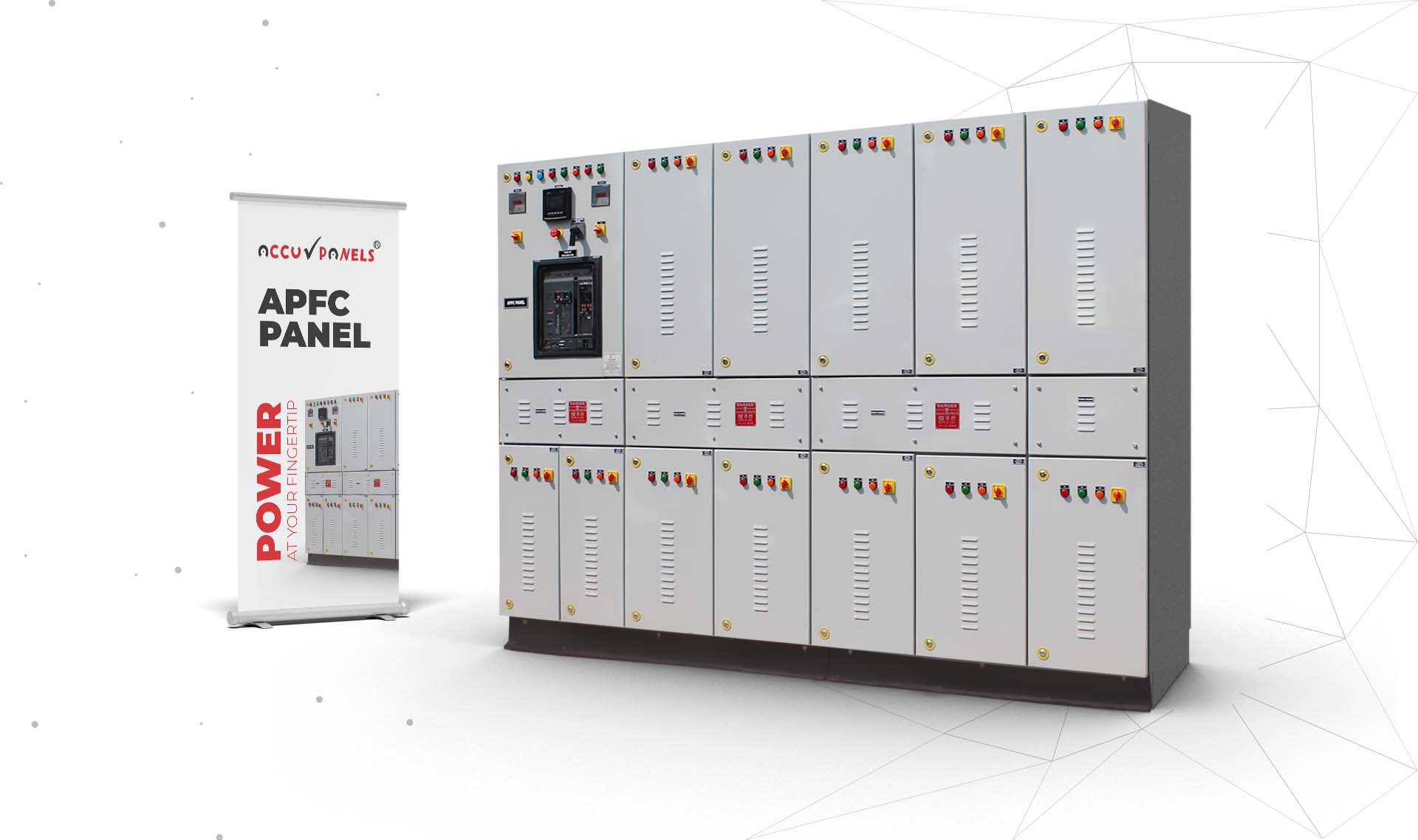
APFC panels: the fastest way to cut industrial electricity penalties
Function of APFC Panel
APFC panels are used significantly to balance the power factor of state electricity boards. Everyone knows how expensive the electricity bill is in the present age. APFC panel intelligent supervision and fully automatically control the power factor in the factory. APFC panel manufacturer is significantly known as automatic power factor instrument panel. The function of the auto power factor panel consists of a microcontroller-grounded programmable regulator that turns on or off capacitor banks of appropriate capacitance. Working directly in the principle of VAR takes care of 0.99 lag from PF by automatically monitor inductive loads in multiple phases.
Electricity is the main contributor to going artificially. Although there are a number of different ways to control and reduce these costs, the most effective result for energy savings is APFC panels. That is a condensation of Automatic Power Factor Correction and is about automatically managing and correcting the power factor which in turn results in better power efficiency and power quality.
How Does APFC Panel Work in Industries ?
The role of APFC panels is to nullify the counter effect lagging reactive power that is caused by inductive loads like induction motors. These microprocessor-powered panels identify lagging reactive power and automatically corrects power factors by injecting reactive power to the grid by turning ON capacitor banks. There are many different types of customized APFC panels available for power requirements from 30kVAr to 1000kVAr according to the client’s requirement.
Why apfc important in Industrial or Commercial LT Panels ?
In commercial and industrial areas, having large electricity loads is a common thing. But, managing these loads manually can often lead to loss and wastage of energy and when overused can also lead to penalties. Instead of this, industries can switch to APFC panels and overcome this problem by employing the power of automation and ensure that you effectively maintain the utility power factor.
Types of APFC Panel
There are two types of APFC panels which are APFC and RTPFC Panels. While the one is an Automatic power factor improvement Panel, the RTPFC is an advanced real-time power factor correction panel. Employing these panels can account for an average savings of 30% energy and can also ensure that it provides quality of power to the LT Panels. Employing these panels can remove the headache of manual switching; power loss and instead lead to intelligent switching of power factor operation, ensure fast and real-time response and provide high break relay Polarity reversal indication
- Reduces the risk of operational issues and power harmonics
- Consistent power factor correction when the premise faces fluctuating power loads
- Enjoy the User-friendly interface designed for semi-skilled workers
- Minimize the harmonic disruption
- Protect your electronic equipment from damage and harmonics
- Leading and Lagging both Power factor Control in Solar Applications
APFC Panels are designed as per IS standard IS 8623, IEC 61439 part 1,2 &3
RTPFC or APFC panel Main Application in Various Industrial and Commercial Distribution system :
- Automobile Industry
- Metal Industry
- Pharmaceutical Industry
- Cement Industry
- Chemical Plant
- Power Stations
- Textile Industry
- Printing Industries
- Railways
- Hospitals
- Banks and IT Parks
- Commercial Complexes
- Food Processing Plants
Accu-Panels Energy designs and manufactures APFC panels from 20 kVAr to 3000 kVAr at its ISO 9001:2015 certified works in Ahmedabad, on the same CPRI type-tested IEC 61439 platform as its PCC and MCC panels. Capacitor banks, detuned reactors, thyristor or contactor switching and the APFC relay are selected from your load profile and harmonic survey, and every panel is routine-tested before dispatch. We supply and export to industrial, commercial and solar clients across India, Africa and the Middle East.
APFC panel technical specifications
| Parameter | Accu-Panels standard range |
|---|---|
| Design standard | IEC 61439-1/2 assembly; capacitors per IEC 60831-1/2; reactors per IEC 60076-6 |
| Rated voltage | 415 V AC, 3-phase, 50 Hz (capacitors rated 440 V / 480 V / 525 V for detuned banks) |
| Compensation range | 20 kVAr to 3000 kVAr in steps of 5 / 10 / 25 / 50 / 100 kVAr |
| Switching | Capacitor-duty contactors (standard) or thyristor switching modules for fast, transient-free switching (real-time PFC) |
| Harmonic mitigation | Detuned reactors at 7 % (189 Hz) or 14 % (134 Hz) where THD(I) or non-linear load exceeds 15–20 % |
| Controller | Microprocessor APFC relay, 6 to 14 steps, target PF 0.99 lag, with Modbus communication option |
| Protection | MCCB incomer, HRC fuse or MCCB per step, capacitor discharge resistors, thermostat-controlled ventilation |
| Degree of protection | IP42 / IP54 indoor with forced ventilation; IP55 outdoor |
| Short-time withstand | 50 kA / 65 kA for 1 s busbar system |
| Enclosure | 2.0 mm CRCA frame, 1.6 mm doors, 7-tank pre-treatment and powder coating; louvres and filters for capacitor cooling |
How much kVAr do you need?
Required kVAr = kW × (tan φ1 − tan φ2), where φ1 is the existing power-factor angle and φ2 the target. Example: a 500 kW plant running at 0.80 PF needs about 500 × (0.75 − 0.14) ≈ 305 kVAr to reach 0.99. Our engineers size the bank from your maximum-demand meter readings or a 7-day load survey, and add 10–15 % margin for future load. Detuned reactors are recommended when VFDs, UPS or rectifier loads make up a significant share of the connected load.
Applications
- Textile, plastics, cement and steel plants with large induction-motor loads
- Commercial buildings, hospitals and data centres paying DISCOM power-factor penalties
- Solar plants and hybrid systems needing reactive-power support at the grid interface
- Fed from an upstream PCC panel; combined with MCC and VFD panels for complete plant electrical packages
Frequently asked questions
What is the function of an APFC panel?
It monitors the plant power factor continuously and switches capacitor steps in or out automatically to keep it near unity, avoiding utility penalties and reducing current, losses and voltage drop. Read our detailed guide on the function of an APFC panel.
When do I need detuned reactors?
When non-linear loads (VFDs, UPS, rectifiers, LED drivers) exceed roughly 15–20 % of the load, or a harmonic survey shows THD(V) above 5 %. Plain capacitors can resonate with harmonics and fail early; detuned reactors shift the resonance below the 5th harmonic.
Contactor or thyristor switching?
Contactor switching is economical for steady loads such as textile mills. Thyristor switching responds within one cycle and suits welding, cranes, presses and other rapidly fluctuating loads.
What is the typical payback?
Where a DISCOM levies power-factor penalties or offers incentives, APFC panels commonly pay back within 6 to 18 months through penalty avoidance and lower kVA demand.
Do you supply APFC panels for 800 V solar systems?
Yes. Reactive-power compensation for 800 V AC string-inverter plants is engineered with appropriately rated capacitors and reactors.
Share your electricity bill and load data and our team will size the APFC bank and quote within 48 hours.


