Electrical Control Panels

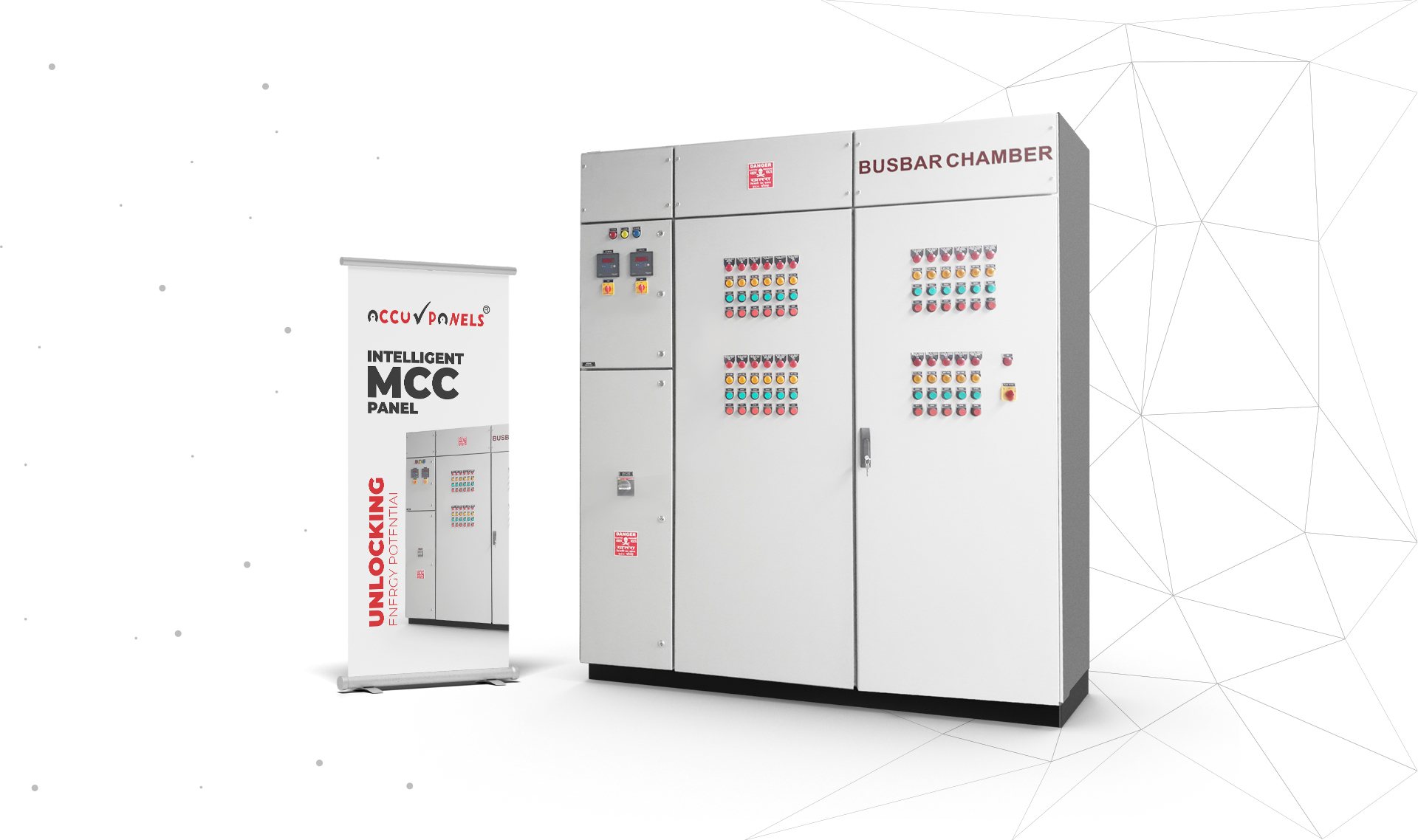
Intelligent Motor Control Centres: Form 4b, fieldbus-connected motor management
An Intelligent Motor Control Centre (IMCC) replaces the conventional contactor-and-overload-relay starter with an intelligent motor management relay per feeder that measures current, voltage, power and thermal state, protects the motor (overload, phase loss, earth fault, under-load, stall, PTC temperature), controls it, and reports everything to the plant DCS or SCADA over Modbus, Profibus, Profinet or IEC 61850. Accu-Panels Energy builds IMCCs in Form 4b drawout construction to IEC 61439-2 on its CPRI type-tested platform in Ahmedabad for process, oil and gas, water and power-plant auxiliary applications.
- Assembly: IEC 61439-1/2, Form 4b, CPRI type-tested design
- Motor starters: IEC 60947-4-1 with type 2 coordination
- Intelligent relays: IEC 60947-4-1 / IEC 60255; communication per Modbus, Profibus DP, Profinet or IEC 61850
- Degree of protection: IEC 60529
- EMC: IEC 61000-6-2 / 6-4 layout practices
Intelligent Motor Control Center (IMCC Panel) Key Features:
IMCC panels embody a suite of advanced features that revolutionize motor control and system management:
Enhanced Process Efficiency: By integrating smart functionalities and streamlined control mechanisms, IMCC panels optimize the overall process, improving efficiency and operational workflows.
Space Optimization and Rapid Setup: Their compact design efficiently utilizes space while facilitating quicker commissioning and startup procedures, reducing setup times significantly.
Advanced Motor Protection: IMCC panels incorporate cutting-edge protection mechanisms, safeguarding electric motors against various electrical anomalies, ensuring longevity and sustained performance.
Mitigated Downtimes: Through proactive monitoring and predictive maintenance capabilities, these panels minimize unscheduled downtimes, contributing to increased operational continuity.
Cost-Effective Maintenance Approach: By employing sophisticated monitoring and diagnostic tools, IMCC panels assist in preemptive maintenance, reducing overall maintenance costs and saving valuable time.
Enhanced Productivity: The integration of intelligent control systems and efficient motor management fosters optimized productivity across diverse industrial processes, promoting seamless operations.
Intelligent Communication Protocols: IMCC panels establish sophisticated communication links with PLCs (Programmable Logic Controllers), DCS (Distributed Control Systems), and BMS (Building Management Systems), enabling seamless data exchange and coordinated control for enhanced system performance and adaptability.
Application of IMCC
- Manufacturing Plants
- Oil and Gas Industry
- Water Treatment Facilities
- Commercial Buildings
- Mining Operations
- Renewable Energy
- Transportation Sector
- Food and Beverage Industry
- 415 V AC, 3-phase, 50 Hz (690 V on request); control 110 V AC / 24 V DC
- Main busbar 800 A to 6300 A; vertical droppers up to 1600 A
- Short-time withstand 50 kA / 65 kA / 80 kA for 1 s
- Feeders: DOL, reversing, star-delta, soft-starter and VFD modules 0.37 kW to 400 kW; feeder modules to 630 A
- Drawout modules with connected / test / isolated positions, shutters and interlocks
- Redundant fieldbus ring or dual-master option; hard-wired ESD / safety trip independent of the network
- IP42 / IP54 (IEC 60529); 2.0 mm CRCA frame, 1.6 mm doors, 7-tank pre-treatment, powder coated
What the plant gains from an IMCC
- Predictive maintenance: per-motor running hours, start counts, thermal capacity and trend data flag bearing or load problems before failure.
- Fewer cables: one fieldbus pair replaces dozens of hard-wired status and command cores per feeder.
- Faster commissioning and diagnostics: trip cause and last-fault records are read from the control room.
- Energy data: kW and kWh per motor for ISO 50001 energy management.
Frequently asked questions
How is an IMCC different from a conventional MCC?
A conventional MCC uses contactors with thermal overload relays and hard-wired status contacts. An IMCC uses an intelligent motor management relay per feeder that adds measurement, advanced protection and fieldbus communication.
Which protocols do you support?
Modbus RTU/TCP, Profibus DP, Profinet, Ethernet/IP and IEC 61850, depending on the relay platform and your DCS.
Is drawout construction mandatory for an IMCC?
No, but it is usual: intelligent feeders are specified where uptime matters, and drawout modules complete the zero-downtime philosophy.
What happens if the network fails?
Relays keep protecting and can hold or fail-safe the motor per configuration; critical trips and ESD are hard-wired independently of the fieldbus.
Lead time?
8 to 12 weeks after drawing approval, including relay configuration and factory acceptance testing with your automation team.
Have a motor list and control philosophy? Send them to our engineering team for an IMCC proposal.


