
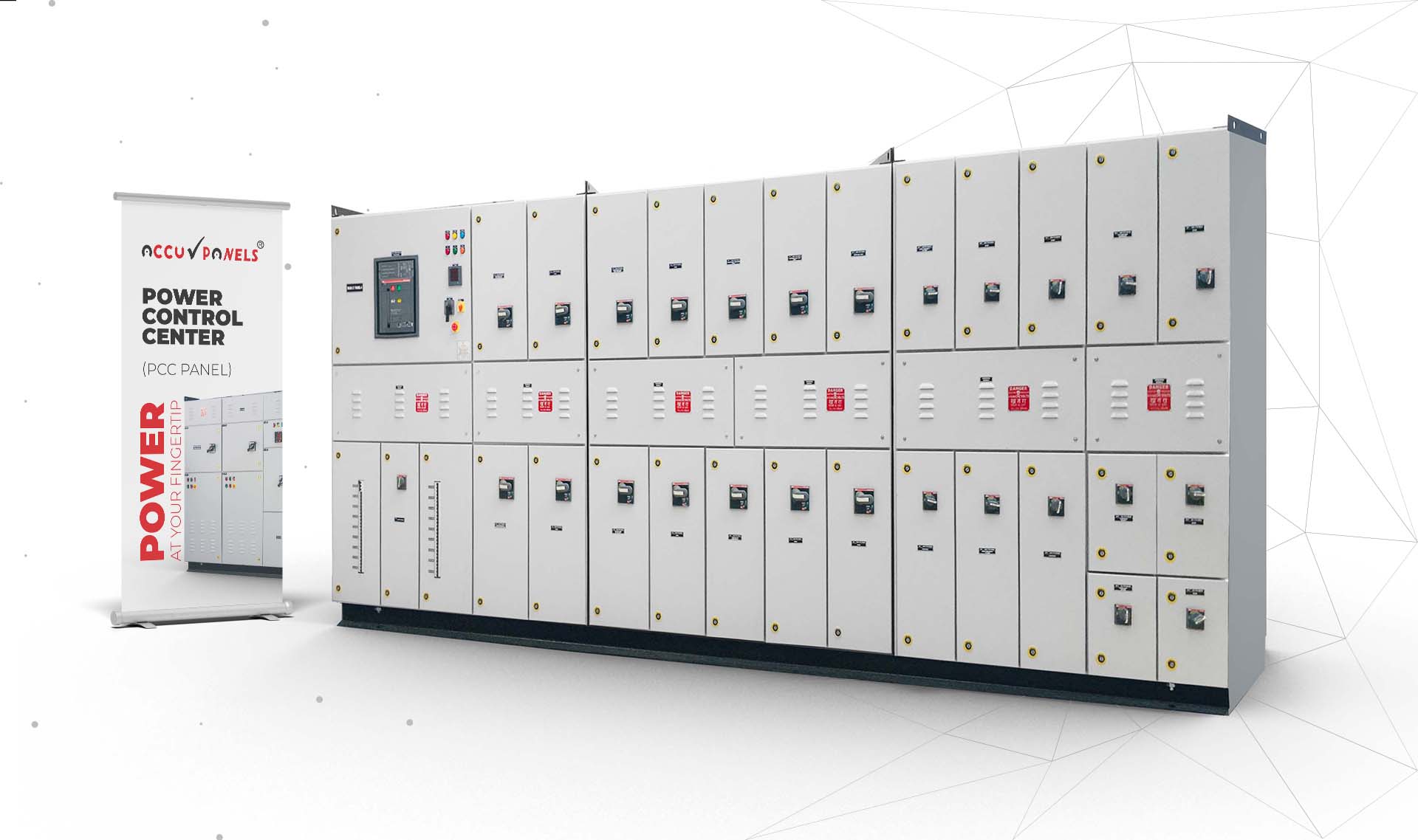
PCC Panel Manufacturer in India

PCC panel full form and function

PCC panel full form: Power Control Centre. It is the main low-voltage switchboard that takes supply from the transformer or DG set, protects it with an incoming ACB and distributes it to the plant through MCCB and ACB outgoing feeders. Accu-Panels Energy is a CPRI type-tested PCC panel manufacturer in Ahmedabad, India, building IEC 61439-2 power control centres from 100 A to 6300 A with 50 kA to 80 kA short-time withstand and Form 2b to Form 4b internal separation.

Our PCC panels are fabricated from laser-cut CRCA sheet with 7-tank pre-treatment and powder coating, fitted with copper or aluminium busbars sized for the specified fault level, and wired with ACB, MCCB and SFU switchgear from leading global brands. Each panel is routine-tested to IEC 61439-1 before dispatch and shipped with drawings, test certificates and warranty.

Electrical abbreviations and symbols in PCC panel:

  1. PCC: Power Control Centre
  2. MCC: Motor Control Centre
  3. PMCC: Power and Motor Control Centre
  4. AMF: Auto Mains Failure panel
  5. APFC: Automatic Power Factor Correction panel
  6. ACB / MCCB / MCB: Air, moulded-case and miniature circuit breakers
  7. Icw: Rated short-time withstand current (kA for 1 s)
  8. IP: Ingress protection rating per IEC 60529

A PCC (Power Control Centre) panel is the main distribution switchboard of an industrial or commercial installation. It receives power from one or more sources such as transformers and DG sets, provides short-circuit and overload protection through ACBs and MCCBs, meters the energy, and distributes it to sub-panels and heavy loads. Because it sits at the top of the LT system, its fault-withstand rating, busbar design and form of separation decide the safety and uptime of the whole plant.

Accu-Panels PCC panels are designed for rated currents from 100 A to 6300 A and rated short-time withstand currents of 50 kA, 65 kA or 80 kA for 1 second, at 415 V AC (690 V and 800 V AC options available). Busbars are electrolytic copper or aluminium, sized by temperature-rise design verification per IEC 61439-1, with SMC/DMC supports and heat-shrink insulation.

Indoor PCC panels are built to IP42 or IP54; outdoor panels to IP55 or IP65 per IEC 60529. Enclosures use 2.0 mm CRCA frames with 1.6 mm doors and covers, laser-cut and CNC-bent, finished with 7-tank pre-treatment and powder coating (C5 anti-corrosion system for coastal and solar sites). Internal separation is offered in Form 1, 2b, 3b, 4a and 4b as defined in IEC 61439-2.

Recent PCC deliveries include SCADA-ready metering with Modbus RTU/TCP multifunction meters, arc-flash-conscious layouts with segregated cable alleys, energy-management CT wiring for ISO 50001 audits, and bus-coupler schemes with automatic changeover or DG synchronising logic. Drawout ACB execution and Form 4b compartmentalisation are available where zero-downtime maintenance is specified.

Main LT distribution for manufacturing plants, textile and pharmaceutical units, chemical and process industries, commercial buildings, hospitals, hotels, data centres, infrastructure projects and solar power plants (including 800 V AC solar LT distribution). PCC panels feed downstream MCC, APFC, lighting and power distribution boards and bus ducts up to 6300 A.

What a Power Control Centre (PCC) panel does

A PCC panel (Power Control Centre) is the main low-voltage switchboard of a plant. It receives supply from the transformer or DG set, protects it with an incoming air circuit breaker (ACB), and distributes it through MCCB or ACB outgoing feeders to motor control centres, APFC panels, lighting boards and other loads. Every PCC panel from Accu-Panels Energy is a CPRI type-tested design built to IEC 61439-1/2, manufactured at our Kathwada GIDC works in Ahmedabad and supplied across India and to export markets in Africa and the Middle East.

PCC panel technical specifications

ParameterAccu-Panels standard range
Design standardIEC 61439-1 & IEC 61439-2 (IS/IEC 61439); type-tested at CPRI
Rated operational voltage (Ue)415 V AC, 3-phase 4-wire, 50 Hz (690 V and 800 V AC variants available)
Rated insulation voltage (Ui)690 V / 1000 V
Rated current of main busbar (InA)100 A to 6300 A
Rated short-time withstand current (Icw)50 kA, 65 kA or 80 kA for 1 s, as per fault level of the installation
Form of internal separationForm 1, 2b, 3b, 4a or 4b per IEC 61439-2
Degree of protection (IEC 60529)IP42 / IP54 indoor; IP55 / IP65 outdoor
Busbar materialElectrolytic copper (tin-plated on request) or aluminium; heat-shrink sleeved; SMC/DMC supports
Enclosure2.0 mm CRCA frame, 1.6 mm doors and covers; 7-tank pre-treatment and powder coating; C5 anti-corrosion finish for coastal and solar sites
ConstructionFixed, semi-drawout or fully drawout; single-front or double-front; front or rear cable entry
Incomer / outgoing switchgearACB incomers up to 6300 A; MCCB / ACB / SFU outgoings; bus couplers with auto-changeover or synchronising logic
Metering & protectionMultifunction meters, class 1 / 0.5 CTs, numerical protection relays, Modbus RTU / TCP for SCADA and energy management
Routine tests (IEC 61439-1 clause 11)Dielectric test at 2.5 kV for 1 min, insulation resistance, wiring and functional checks, IP and clearance verification, torque audit on every unit

Choosing the right form of separation

Form 2b separates busbars from functional units and suits most industrial distribution. Form 3b adds separation between functional units, so a feeder can be worked on while its neighbours stay live. Form 4b additionally separates the outgoing terminals of every unit in their own compartments, which is what hospitals, data centres, pharma and continuous-process plants specify when downtime is not acceptable. Our engineers recommend the form of separation from your single-line diagram (SLD) and maintenance philosophy rather than defaulting to the most expensive option.

Drawings and factory acceptance tests

Before fabrication starts you receive the general arrangement (GA) drawing, single-line diagram, bill of materials, general notes and control schematics for approval. Before dispatch you or your consultant can witness the factory acceptance test (FAT): dimensional check, bill-of-materials verification, functional and interlock checks, two-lamp series (continuity) test, insulation resistance test and the high-voltage test at 2.5 kV for one minute, all recorded on the routine test certificate per IEC 61439-1.

Where PCC panels are used

  • Main LT distribution in manufacturing plants, textile mills, pharmaceutical and chemical units
  • Commercial buildings, hospitals, hotels, malls and data centres
  • Solar power plants: main PCC downstream of inverter transformers, including 800 V solar LT panels
  • DG and grid changeover or synchronising schemes with synchronising panels and AMF panels
  • Feeding downstream MCC panels, APFC panels and bus ducts up to 6300 A

Why buyers specify Accu-Panels PCC panels

  • Type-tested, not just “as per IEC”. Our design has been through short-circuit, temperature-rise, dielectric and IP testing at CPRI. Read what IEC 61439 type-tested actually means.
  • ISO 9001:2015 and CE-marked manufacturing with documented routine tests on every panel before dispatch.
  • Engineering support: GA drawings, busbar sizing, fault-level calculations and SLD review before fabrication.
  • Two decades of delivery to industrial, commercial and renewable clients in India, Africa and the Middle East.

Frequently asked questions

What is the difference between a PCC and an MCC panel?

A PCC distributes power from the source to major loads and sub-panels; an MCC controls and protects individual motors with starters, contactors and overload relays. In most plants the PCC feeds the MCC. See our guide What are MCC and PCC panels?

Which fault level should I specify?

Specify the prospective short-circuit current at the panel incomer, calculated from the transformer kVA and impedance (for example, a 2000 kVA, 6.25 % transformer gives roughly 44 kA at 415 V). We then select a 50 kA, 65 kA or 80 kA Icw design with matching breaker breaking capacity.

Do you supply drawout PCC panels?

Yes. ACB incomers and outgoings can be supplied in drawout execution so a breaker can be racked out for maintenance without shutting down the busbar.

What documents come with the panel?

Approved GA and schematic drawings, bill of materials, routine test certificate per IEC 61439-1, warranty certificate and the CPRI type-test report reference for the design.

What is the typical lead time?

Standard PCC panels are typically delivered in 4 to 6 weeks from drawing approval, depending on switchgear availability and panel size. Share your SLD and load list for a firm schedule.

Ready to specify? Send your single-line diagram to our engineering team for a techno-commercial offer within 48 hours.

