
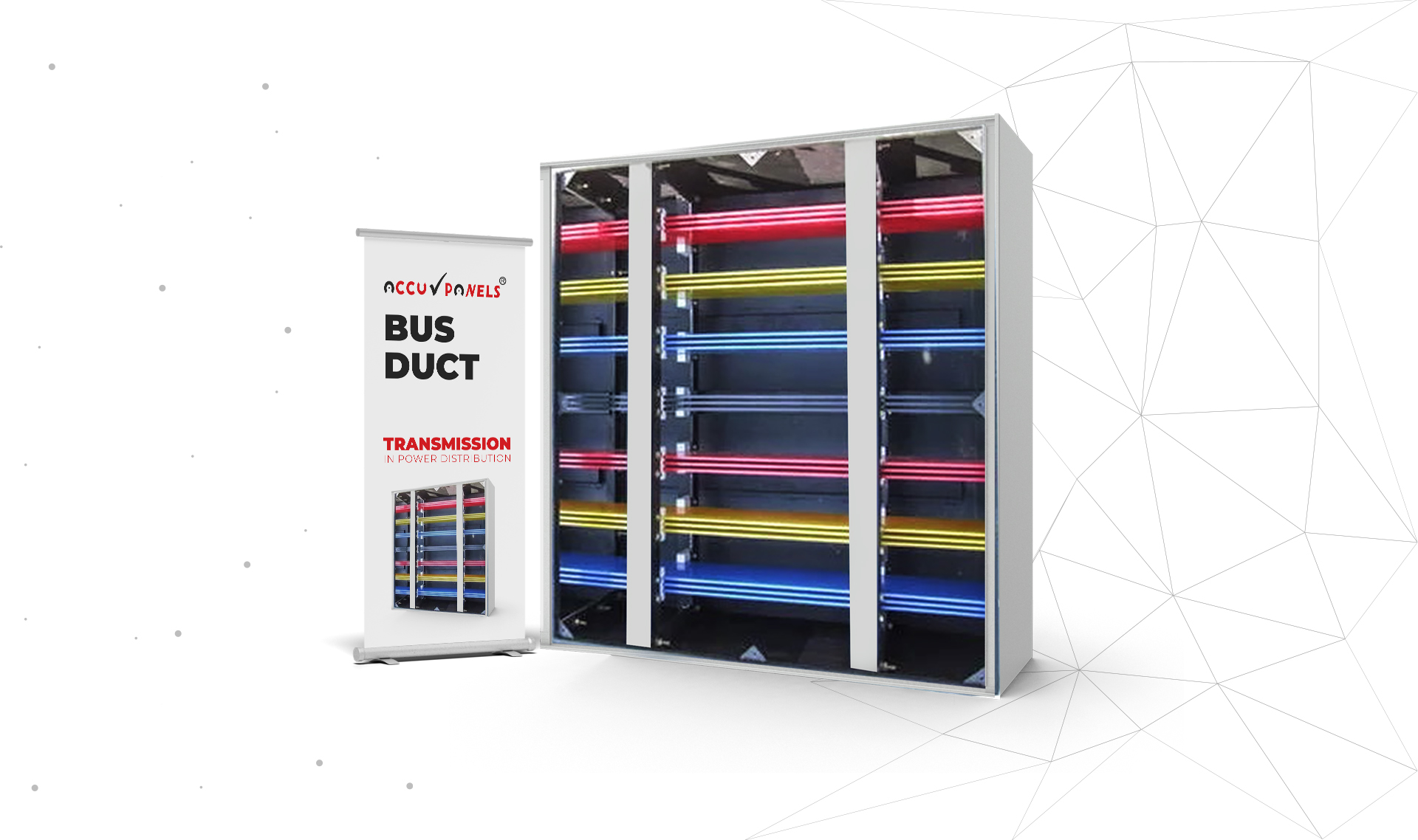
LT bus ducts up to 6300 A: lower losses than cables, faster installation
What is Bus duct in electric power distribution :
Bus duct is a duct Container including either copper or aluminum busbar for the purpose of conducting a substantial current. In electric power distribution, a bus duct conducting electricity to power cables or cable bus.
Why bus-duct is used instead of cable?
Installing power cables is more difficult and takes a lot more manpower and more time on site and can only be done by highly specialized electricians. However, bus-duct can be installed quickly, efficiently and with ease resulting in a significant reduction in on-site costs. Busbars also have a limited increase in reactive power to operate compared to cable systems. Their design also reduces the distance between conductors as well as resistance and Reduces voltage loss.
Accu-Panels Energy is one of the most trusted manufacturing company for air insulated busduct upto 6300A 65KA fault level. Air insulated busduct is more cost effective and reliable than sandwich duct.
Air insulated Bus-duct is mostly used for industrial and commercial sites like malls, multiplex, hospital, solar power plants for effective and efficient supply of electricity. Air insulated busduct is approved by CPRI and major electrical consultant in india.
For effective and efficient supply of electricity, bus-ducts are used in industrial places to distribute power to various loads without facing any kind of difficulty.
In Electrical Power Distribution a bus-duct also called the busway. The bus duct is used for effective and reliable supply in electricity for industrial locations. In other words, the busway system is an effective method of distributing power from switchgear to loads.
Bus duct designed as per IS standard IS 8623, IEC 60529. In addition, all switches and the circuit breakers, connectors conformed to IEC 60947, part I, II and III/ IS 60947 part I, II and III.
We manufacturing the Electrical bus duct with a high standard of quality and reliability. As a result, Accupanels is a top 10 electrical bus duct manufacturer in India. Enclosure designed with rated current ranging from 100A to 6300A and up to 65KA and 80KA fault level.
Firstly, all indoor enclosure have protected of IP52 or better even more all outdoor enclosure has protected with up to IP65 . Secondly, all enclosure made by laser cutting CRCA sheet and powder coating with the 7-Tank process system.
All the enclosure with metal clad, totally enclosed, rigid, floor mounted, air-insulated, cubical type suitable for operation on three-phase / single phase,415 or 230 volts, 50 Hz. They have designed for a minimum expected ambient temperature of 45 degrees Celsius. Also 80 percent humidity and dusty weather.
Mostly the bus duct of Accu-panels is used to carry large currents between LT panels and transformers or generators. And the best thing about cable bus duct is that it is very lower in price in comparison to power cables.
Bus duct technical specifications
| Parameter | Accu-Panels range |
|---|---|
| Types | Air-insulated (segregated / non-segregated phase) bus duct; compact sandwich busbar trunking; rising mains for buildings |
| Rated voltage | 415 V / 690 V / 800 V AC, 50 Hz; Ui 1000 V |
| Rated current | 400 A to 6300 A (higher on request) |
| Short-time withstand (Icw) | 50 kA / 65 kA for 1 s (80 kA on request) |
| Conductor | Electrolytic copper (E-Cu ETP) or EC-grade aluminium, tin- or silver-plated joints, heat-shrink or epoxy insulation; TPN / TPN + 50 % or 100 % neutral + PE |
| Enclosure | 2.0 mm CRCA or 3 mm aluminium, 7-tank pre-treatment and powder coating; IP52 indoor, IP55 / IP65 outdoor with canopy and breathers |
| Accessories | Flanged ends for transformer and panel, expansion joints, fire barriers, wall flanges, bends, tees, adaptor boxes, plug-in tap-off boxes (trunking) |
| Standards | IEC 61439-1 and IEC 61439-6 (busbar trunking systems), IS 8623, IEC 60529 |
Bus duct or cables?
For a 2500 A transformer-to-PCC link, a cable solution needs multiple parallel single-core cables per phase, cable trays, terminations at both ends and careful derating. A bus duct carries the same current in one enclosed conductor system with lower resistance (lower I²R losses), no derating for grouping, a smaller footprint and a factory-tested joint every metre. Above about 1600 A, or where the run is short and the cable count large, bus duct is normally cheaper over the life of the installation.
Frequently asked questions
What is the difference between bus duct and busbar trunking?
Both are enclosed busbar systems. “Bus duct” usually means an air-insulated transformer-to-panel or panel-to-panel link; “busbar trunking” (sandwich type) is compact, epoxy- or film-insulated and often has plug-in tap-offs for distribution along its length.
Copper or aluminium conductors?
Aluminium reduces cost and weight; copper reduces cross-section and joint count. We size both and quote the option that best fits your rating, length and site.
Can you supply outdoor bus duct?
Yes. IP55 / IP65 with sloped canopy, breathers, drain points and C5 coating for transformer yards and coastal sites.
How is a bus duct joined on site?
Sections are factory-drilled and shipped with plated joint plates, high-tensile bolts and torque specification; our team supervises erection and performs insulation-resistance and continuity tests.
Lead time?
4 to 6 weeks after site measurement and drawing approval.
Send your transformer rating, panel location and route length to our engineering team for a bus duct layout and offer; see also our PCC panels.


