
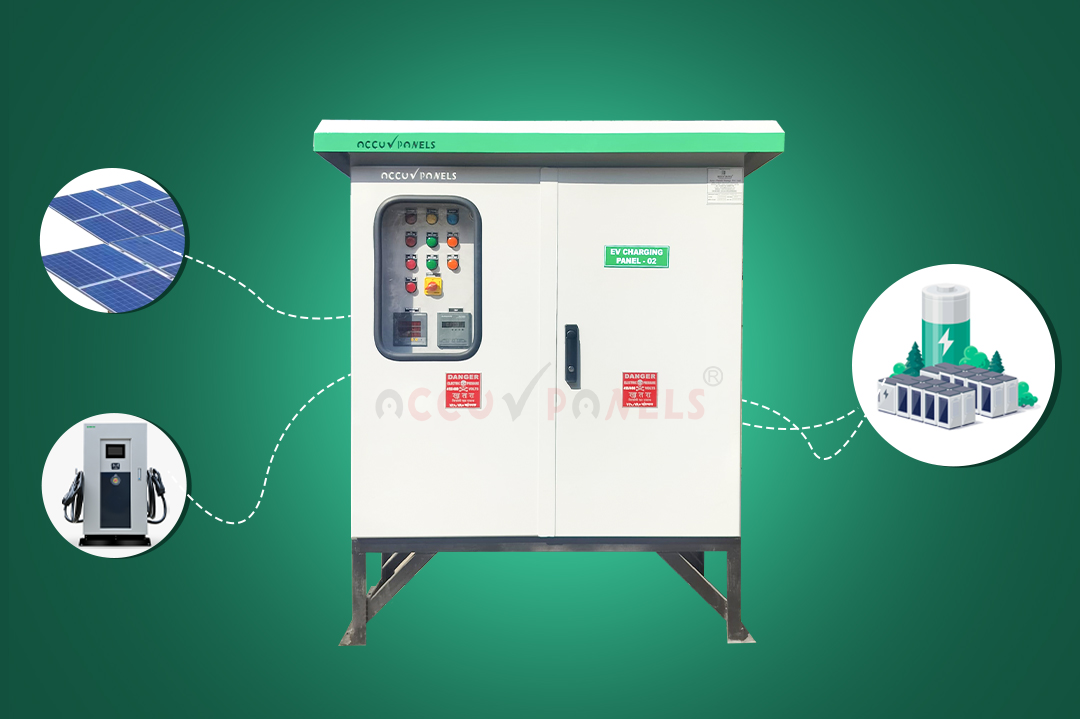
LT panels for EV charging hubs: up to 85 kA, CPRI type-tested
Electrical LT panels are essential in EV infrastructure as they ensure safe and efficient power distribution to chargers while enabling load management, fault protection, and real-time monitoring. Their integration with smart technologies like PLCs, energy meters, and RS-485 communication supports dynamic charging, source synchronization, and predictive maintenance. With compliance to IEC 61439 and CPRI-certified designs, IP65 LT panels from Accu-Panels provide scalable, reliable, and future-ready solutions tailored for India’s growing EV ecosystem. The future of EVs, BESS (Battery Energy Storage Systems), and electrical infrastructure is converging into a high-efficiency, smart, and sustainable energy ecosystem—driven by innovation, policy, and grid modernization.
✅ EV Charging Distribution Panels
- Designed to handle high current loads from multiple EV chargers.
- Integrated energy metering (RS-485 enabled) for billing and analytics.
- Built with IP65 enclosures for outdoor deployment.
✅ EV Load Management Panels
- PLC-integrated for dynamic load balancing across chargers.
- Supports smart charging protocols and tariff-based control.
- Ideal for fleet yards, commercial hubs, and multi-unit charging stations.
✅ EV Transformer Panels
- Ensures safe step-down voltage from HT to LT for EV stations.
- Built with short-circuit withstand capacity up to 85kA (CPRI-tested).
- Compliant with IEC 61439 and IS standards.
✅ EV Synchronization Panels
- Enables seamless integration of DG, solar, and grid sources.
- Supports auto changeover and real-time fault diagnostics.
- SCADA-ready with microprocessor-based relays.
✅ Smart Metering ACDBs
- RS-485 enabled for remote monitoring and predictive maintenance.
- Supports IoT connectivity and energy dashboards.
- Used in both public and private EV charging setups.
Accu-Panels stands out in the EV and BESS space by offering CPRI-certified, IEC-compliant LT panels that are engineered for high-voltage, high-efficiency, and smart energy applications. Their panels support up to 800V AC, enabling faster EV charging and seamless integration with solar and battery systems. With features like draw-out modules, RS-485 metering, and SCADA-ready architecture, Accu-Panels ensures minimal downtime, predictive maintenance, and real-time diagnostics. For BESS, their hybrid ACDBs, DC coupling panels, and synchronization units allow bidirectional energy flow, grid stability, and optimized renewable dispatch. In short, Accu-Panels delivers modular, scalable, and future-ready electrical solutions that empower India’s clean energy transition.
An EV charging hub is a concentrated, fast-changing load: a bank of 60 kW to 240 kW DC fast chargers can draw more than a small factory, switches on and off through the day, and injects harmonics from its rectifiers. The EV charging LT panel takes the DISCOM or transformer supply, protects and meters it, distributes it to each charger with a dedicated MCCB feeder, and provides surge protection, earth-fault protection and space for load management or energy metering per charger. Accu-Panels builds these panels on its CPRI type-tested IEC 61439 platform for charge-point operators, fleet depots, malls, highways and housing societies.
- Assembly: IEC 61439-1/2 (IS/IEC 61439), CPRI type-tested design
- Switchgear: IEC 60947-2 breakers, IEC 60947-3 switch-disconnectors
- Surge protection: Type 1+2 / Type 2 SPD per IEC 61643-11
- Earth leakage: RCD / RCBO Type A or Type B (for DC-fault sensitivity) per IEC 62423 where chargers require it
- Enclosure protection: IEC 60529 (IP54 indoor, IP65 outdoor)
- Compatible with charger installations per IEC 61851 and Indian MoP / BEE charging infrastructure guidelines
- 415 V AC, 3-phase 4-wire, 50 Hz (800 V AC on request for high-power charger sites)
- Incomer 250 A to 4000 A, ACB or MCCB with metering and TOD-ready energy meter provision
- Charger feeders: MCCB 63 A to 400 A per charger, with RCD and surge protection as specified
- Short-time withstand up to 85 kA (CPRI-tested), typically 50 kA / 65 kA
- Detuned APFC section or harmonic filter provision for large hubs
- IP54 indoor / IP65 outdoor with canopy; 2.0 / 1.6 mm CRCA, 7-tank pre-treatment, powder coat or C5 finish
- Load-management ready: Modbus RTU / TCP energy meters per feeder, auxiliary contacts to the CPO back-end
Public fast-charging stations, highway charging plazas, bus and fleet depots, mall and office car parks, housing-society charging bays, and solar-plus-storage charging hubs where the panel also interfaces with solar ACDBs and battery systems.
Sizing the LT panel from charger kW
| Charger mix (example) | Connected load | Typical incomer at 415 V | Feeder MCCB per charger |
|---|---|---|---|
| 4 × 7.4 kW AC + 2 × 30 kW DC | ≈ 90 kW | 250 A MCCB | 40 A (AC) / 63 A (DC) |
| 6 × 60 kW DC | ≈ 360 kW | 800 A ACB / MCCB | 125 A |
| 8 × 120 kW DC | ≈ 960 kW | 2000 A ACB | 250 A |
| 6 × 240 kW DC (bus depot) | ≈ 1440 kW | 3200 A ACB | 400 A |
Figures assume unity diversity and 0.95 power factor; with load management the incomer can be reduced. We size each panel from your charger datasheets and DISCOM sanctioned load.
Frequently asked questions
Do EV charging panels need special earth-leakage protection?
AC chargers with on-board rectifiers can produce smooth DC fault currents that a Type AC RCD will not detect. Type A RCDs with 6 mA DC detection (or Type B) are specified per charger requirements; we build the feeder accordingly.
Why is surge protection important at charging sites?
Chargers contain sensitive power electronics and are often outdoors with long cable runs. A Type 1+2 SPD at the incomer and Type 2 at outgoing feeders is standard practice.
Can the panel support load management?
Yes. Per-feeder energy meters with Modbus and auxiliary contacts let the charge-point operator’s back-end cap total demand and stay within sanctioned load.
Do you supply APFC for charging hubs?
Yes. A detuned APFC section or harmonic filter can be integrated to manage power factor and THD from charger rectifiers.
Lead time?
3 to 6 weeks after drawing approval for standard hub panels.
Planning a charging site? Share your charger list and sanctioned load for a panel design and quotation.


