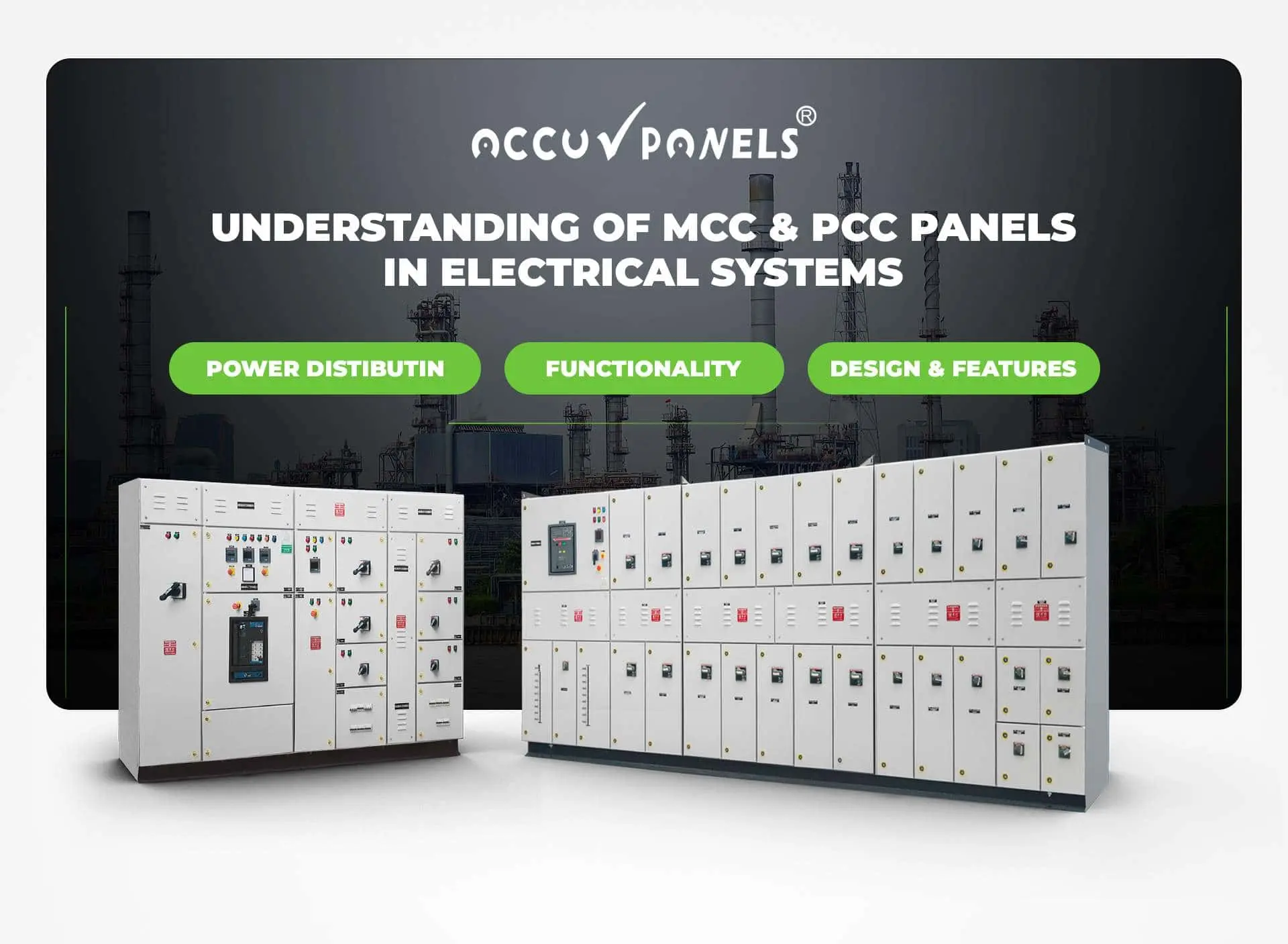
MCC (Motor Control Centre) and PCC (Power Control Centre) panels are the two workhorses of an industrial low-voltage system. The PCC receives power from the transformer or DG set and distributes it; the MCC takes a feeder from the PCC and controls and protects the plant’s motors. Both are built to IEC 61439 and both look like rows of steel cubicles — but their internals, ratings and the way they are specified are quite different. This guide explains each, compares them side by side and shows how they fit together.

What is a PCC panel?
A Power Control Centre is the main LT switchboard. Its incomer is an air circuit breaker (ACB) rated for the transformer’s full-load current — 1600 A to 6300 A on large plants — and its busbar must withstand the prospective fault current (50 kA to 80 kA for 1 s) without damage. Outgoing MCCB or ACB feeders supply MCCs, APFC panels, lighting and power distribution boards, bus ducts and large individual loads. Metering, protection relays, bus couplers and changeover or synchronising logic between transformers and DG sets also live here. Because everything downstream depends on it, the PCC is specified with the highest fault rating and, in critical plants, Form 3b or 4b internal separation. See our PCC panel specifications.
What is an MCC panel?
A Motor Control Centre is a modular assembly of motor starters. Each functional unit contains the switching and protection for one motor: an MCCB or MPCB for short-circuit protection, a contactor for switching, an overload relay (thermal or electronic) for motor protection, and control components — push buttons, selector switches, indicating lamps, auxiliary relays or PLC I/O. Starter types range from direct-on-line (DOL) for small motors, through star-delta for medium motors, to soft starters and variable-frequency drives for large or variable-speed machines. MCCs are supplied fixed, semi-drawout or fully drawout, and as intelligent MCCs with fieldbus communication. See our MCC panel specifications.
MCC vs PCC: side-by-side comparison
| Aspect | PCC panel | MCC panel |
|---|---|---|
| Primary function | Receive and distribute power | Start, control and protect motors |
| Position in the system | Directly after transformer / DG | Fed from a PCC feeder |
| Typical busbar rating | 800 A – 6300 A | 400 A – 2500 A (up to 6300 A) |
| Main switchgear | ACB incomers, MCCB / ACB feeders | MCCB / MPCB + contactor + overload relay per motor |
| Short-circuit withstand | 50 – 80 kA for 1 s | 50 – 65 kA for 1 s |
| Control content | Metering, protection relays, changeover / sync logic | Starters, local/remote control, PLC or fieldbus interface |
| Form of separation | Form 2b – 4b | Form 2b – 4b (4b for drawout / IMCC) |
| Standards | IEC 61439-1/2 | IEC 61439-1/2, IEC 60947-4-1 |
| Who specifies it | Electrical consultant from the SLD and fault study | Process / electrical team from the motor list |
What is a PMCC?
A PMCC (Power and Motor Control Centre) combines both in one lineup: an ACB incomer and distribution feeders on one side, motor starter modules on the other, sharing a common busbar. PMCCs suit small and medium plants where a separate PCC and MCC would be uneconomical.
Types of MCC panels
- Fixed MCC: starters bolted in compartments; most economical; maintenance during shutdown.
- Semi-drawout MCC: plug-in power connections with bolted control connections.
- Fully drawout MCC: withdrawable modules with connected / test / isolated positions; live replacement of a faulty starter.
- Intelligent MCC (IMCC): intelligent motor management relays with Modbus / Profibus / IEC 61850 communication and predictive-maintenance data.
- VFD / soft-starter MCC: drive or soft-starter modules with harmonic filters and cooling built into the lineup.
How Accu-Panels builds both
Accu-Panels Energy manufactures PCC, MCC and PMCC panels on one CPRI type-tested IEC 61439 platform in Ahmedabad: laser-cut 2.0 mm CRCA frames, copper or aluminium busbars sized by temperature-rise verification, 7-tank pre-treatment with powder or C5 coating, and routine dielectric, insulation-resistance and functional tests on every panel. Drawings (GA, SLD, schematics, BOM) are issued for approval before fabrication and the factory acceptance test can be witnessed. Read what IEC 61439 type-tested actually means and our guide to the types of electrical panels used in India.
Both PCC and MCC panels are engineered in-house by Accu-Panels as an electrical control panel manufacturer — the same team also builds VFD, AMF, changeover and synchronising panels, so a complete plant distribution-plus-control package can come from one drawing set.
Frequently asked questions
Can one panel be both PCC and MCC?
Yes — a PMCC. It is common in plants below about 1000 kVA where a single lineup can hold the incomer, distribution feeders and all motor starters.
Which needs the higher fault rating?
The PCC, because it sits closest to the transformer where the prospective short-circuit current is highest. The MCC fault level is reduced by the cable impedance between them, but is often specified equal for simplicity.
Which is more expensive?
Per cubicle, the PCC (large ACBs and heavy busbars). Per project, the MCC often costs more because of the number of starters.
Do MCCs need Form 4b?
Only where live maintenance is required; Form 2b or 3b is adequate for most plants with planned shutdowns.
Specifying a PCC or MCC? Send your SLD or motor list to Accu-Panels Energy for a techno-commercial offer.







Leave a comment