
An LT panel is rated for an air temperature of 40 °C. Much of India spends April to June above that, and the air inside a closed switchboard runs 10 K to 20 K hotter still. Summer is therefore not an unusual condition for a panel; it is the condition under which its ratings are quietly exceeded.
This guide sets out electrical panel summer precautions for plant maintenance teams: the service conditions IEC 61439 assumes, how devices and busbars derate in hot internal air, ten precautions for HT and LT panels, points for 800 V solar LT panels, and a pre-summer checklist with acceptance criteria. It applies equally to power panels, motor control centres, VFD, synchronising and fire-alarm panels.
Figures reflect published standards and product documentation as of November 2026.
Key facts at a glance
- Service condition: Air ≤ 40 °C, 24 h mean ≤ 35 °C (IEC 61439-1:2011, 7.1)
- Busbar correction factor: k4 = 1.35 at 45 °C, 1.00 at 55 °C, 0.77 at 60 °C internal air
- 100 × 10 mm Cu bar: 969 A at 55 °C air; about 746 A at 60 °C
- IP for location: IP52/IP54 indoor; IP65 outdoor with canopy
- Inverter loading in peak heat: Commonly 80–90 % of rating; confirm with data sheets
In this guide
Why Indian summers exceed the design service condition
IEC 61439-1:2011, clause 7.1 defines the normal service condition as ambient air not exceeding 40 °C, with a 24-hour mean not exceeding 35 °C; the 2020 edition keeps the same limits. The temperature-rise limits in Table 6 of the 2011 edition (for example 70 K at terminals for external insulated conductors and 30 K on accessible metal surfaces) are stated relative to that 35 °C mean. When plant-room air is 42 °C and the panel stands in sun, the ambient assumption is broken before any load is applied, and every temperature limit inside the panel is reached at a lower current than the rating suggests.
How devices and busbars derate in hot air
Switchgear data sheets publish rated current at a reference air temperature, commonly 40 °C around the device; above it the manufacturer’s derating table applies. Busbars behave the same way. IEC 61439-1:2011, Annex N gives the current of bare copper bars for 55 °C air inside the enclosure and a 70 °C conductor, and Table N.2 gives correction factors for other air temperatures. As a typical illustration, a 100 × 10 mm single bar listed at 969 A carries about 1,308 A at 45 °C internal air but only about 746 A at 60 °C: a loss of about 23 % for the last 5 K of air temperature rise. Application notes from leading international switchgear manufacturers give similar curves and recommend checking internal air temperature, not only room temperature, when a panel trips in summer.
| Internal air temperature | Correction factor k4 (70 °C conductor, IEC 61439-1:2011 Table N.2) | Typical 100 × 10 mm Cu bar |
|---|---|---|
| 35 °C | 1.69 | about 1,638 A |
| 45 °C | 1.35 | about 1,308 A |
| 55 °C | 1.00 | 969 A |
| 60 °C | 0.77 | about 746 A |
The factors apply to bars not verified by test; a tested busbar system follows its report. Either way the direction is the same, which is why a summer heat-load review is worth more than a larger breaker.
Ten electrical panel summer precautions for HT and LT panels
1. Ventilation and cooling
Check that louvres and filters are clean, that fans run in the right direction and that nothing is stored against vents or doors. Replace filters before the season, confirm thermostat set points, and service switchgear-room air-conditioning in March, not June.
2. Loading and derating
Summer raises cooling and pumping loads just as it reduces panel capacity. Compare measured phase currents against the derated capacity, not the nameplate. Where a panel feeds solar inverters, operators commonly limit inverter output to about 80 % to 90 % of rating during peak heat; confirm the figure with the inverter and switchgear data sheets rather than adopting a fixed rule. Any new panel for a hot site should be bought with a heat-load calculation at the actual site ambient.
3. Connections and wear
Inspect for discoloured insulation, frayed control wiring, corroded lugs and loose glands. Torque-check busbar joints and power terminations to the manufacturer’s values with the panel isolated; loose joints are the most common origin of summer failures.
4. Cleanliness and dryness
Blow out dust with dry, oil-free air; dust on insulators lowers creepage and holds moisture when the monsoon follows. Indoor panels should be IP52 or IP54 with doors closed; outdoor panels, and outdoor solar LT panels above all, should be IP65 to IEC 60529 with a canopy or shed to keep the enclosure out of direct sun.
5. Surge protection
Pre-monsoon thunderstorms arrive at the end of summer. Check that surge protective devices are fitted on the incomer, that their status indicators are healthy and that earth leads are short and straight. Replace any SPD showing end-of-life indication.
6. Temperature monitoring
Carry out infrared thermography of every panel under normal load, and log internal air temperature for a week in May; it is the most useful single number for judging whether cooling is adequate. Fit busbar temperature sensors on critical incomers where justified.
7. Scheduled professional maintenance
Plan a pre-summer shutdown for cleaning, torque checks and protection tests, with results recorded against the previous year.
8. Operator awareness
Operators should know the symptoms of overheating, the meaning of panel alarms and the isolation points. A panel that trips should not simply be reset; the cause should be found first.
9. Upgrading older panels
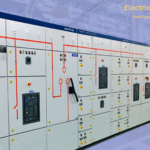
Panels built without design verification, with undersized busbars or with no ventilation provision are candidates for replacement before the season. A typical modern board is described on the electrical LT panel product page, with stated Icw, form of separation and IP rating that can be compared with the installed unit.
10. Emergency procedures
Display the shutdown sequence, emergency contacts and the location of extinguishers suitable for electrical fires at each panel, and rehearse with the shift team.
Additional points for 800 V solar LT panels
- Follow the switchgear manufacturer’s guidelines for 800 V operation; published ratings at 800 V are lower than at 415 V.
- Designers commonly apply a larger derating margin at 800 V because switchgear thermal limits are reached sooner; confirm the factor with the device data sheet rather than using a fixed percentage.
- Verify earth-fault protection on three-wire 800 V systems, where a core-balance current transformer rather than a neutral CT is used.
- Monitor inverter operation and the panel’s internal air temperature together; an inverter that reduces output in heat masks a panel that is also at its limit.
- Use a panel builder with 800 V experience: Ui 1,000 V insulation coordination and 8 kV impulse withstand are not met by re-labelling a 415 V design. The 800 V LT panel product page gives a typical specification for comparison.
Pre-summer checklist
| Item | Frequency | Acceptance criterion |
|---|---|---|
| Thermography of busbars, joints and terminations | Before summer and after load changes | No joint more than 10 K above adjacent conductors at similar load |
| Internal air temperature logging | One week in peak season | Within the design air temperature used for the panel’s rating |
| Fans, filters and louvres | Monthly in summer | Filters clean, fans running, airflow unobstructed |
| Torque check of power connections | Annually, panel isolated | All joints at the manufacturer’s specified torque |
| Load survey against derated capacity | Before summer | Measured current below the derated rating of the device and busbar |
| SPD status and earth lead check | Before monsoon | Indicator healthy; earth lead short, tight and continuous |
| Door gaskets, glands and canopy (outdoor) | Before summer and monsoon | No gaps; IP maintained; enclosure shaded |
| Protection relay and release functional test | Annually | Trip within the set time; settings match the coordination study |
Frequently asked questions
What ambient temperature is an LT panel designed for?
IEC 61439-1 assumes air not exceeding 40 °C with a 24-hour mean not above 35 °C. Where the site exceeds this, the panel must be derated or designed for the higher ambient.
Why does a panel trip in summer at a current it carried in winter?
Device and busbar ratings fall as the air inside the panel warms. A load within limits at 35 °C internal air may exceed the derated rating at 55 °C or 60 °C.
Is IP52 adequate for an outdoor panel?
No. IP52 or IP54 is an indoor rating. Outdoor panels should be IP65 to IEC 60529 and should still be shaded by a canopy, because IP describes protection against dust and water, not against heat.
Related reading
Disclaimer. This article is general engineering information based on published standards and product documentation as of November 2026. Ratings, settings and protection schemes must be confirmed by a qualified engineer for each installation. Nothing here is a design specification.
Author: Ghanshyam Soni, Managing Director





Leave a comment