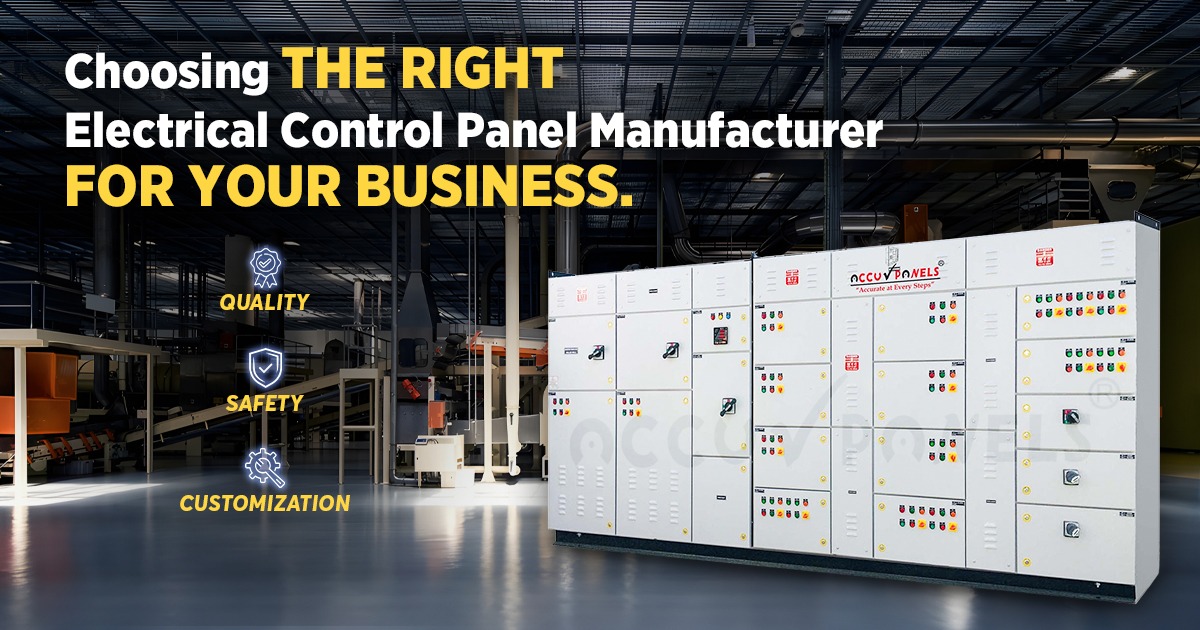
An electrical panel is bought once and lived with for twenty years. The switchgear inside it can be replaced; the busbar system, the enclosure and the verification behind them cannot. Choosing who builds the panel is therefore a longer-lived decision than choosing what goes inside it.
This guide sets out how to evaluate an electrical control panel manufacturer in India: the criteria that matter, a step-by-step evaluation process, what IEC 61439 design verification actually proves, and a ten-question checklist to use before any order is placed. It is written for plant engineers, consultants and procurement teams buying LT power and control panels for industrial, infrastructure and renewable projects.
Figures reflect published standards and product documentation as of November 2026.
Key facts at a glance
- Verification: Design-verified to IEC 61439 (by test) plus routine verification of every assembly
- Short-circuit withstand: Icw stated in kA r.m.s. with duration, e.g. 50 kA for 1 s
- Form of separation: Form 2b to 4b per IEC 61439-2
- Enclosure: CRCA 2.0 mm frame, 1.6 mm doors, seven-tank pretreatment
- LT scope: 415 V standard; up to 1,000 V AC for 800 V solar panels
In this guide
- Why the choice of manufacturer matters
- Evaluation criteria for an electrical control panel manufacturer
- A step-by-step evaluation process
- Key technical considerations
- What IEC 61439 design verification means
- LT panel capacity: what “low voltage” covers
- Ten-question buyer checklist
- Frequently asked questions
Why the choice of manufacturer matters
The panel is where the installation’s fault level, load current and protection scheme meet. If the busbar system cannot withstand the prospective short-circuit current, or the enclosure cannot dissipate the heat of the installed devices, no quality of switchgear will compensate. Under IEC 61439-1 the panel builder is the original manufacturer of the assembly and is responsible for its design verification; the switchgear maker is responsible only for the devices. A good manufacturer also shortens the project: correct drawings first time, a factory acceptance test that finds problems before despatch, and support when a setting needs changing two years later.
As of November 2026 the Indian LT panel market ranges from fabricators assembling to customer drawings, through licensed builders on a switchgear maker’s reference design, to manufacturers with their own CPRI-tested platforms. Each can deliver a compliant panel; the buyer’s task is to confirm which category a supplier belongs to and whether the evidence matches the product.
Evaluation criteria for an electrical control panel manufacturer
Experience and product range
Look for a portfolio covering the panel types your project needs: PCC, MCC, APFC, AMF and synchronising panels, distribution boards and solar ACDB and DCDB. Repeated experience of a type means standard drawings, tested busbar arrangements and known lead times.
Quality systems and verification
Three documents matter. An ISO 9001:2015 certificate shows a quality system exists. A design-verification report from CPRI or another NABL-accredited laboratory, covering short-circuit withstand, temperature rise, dielectric properties and IP, shows the assembly design has been verified by test. A CE declaration matters for export projects. Only the verification report proves electrical performance, so it is the one to read carefully.
Customisation and engineering depth
Ask whether the manufacturer can incorporate your protection philosophy, metering and communication requirements, and whether the design can scale with spare feeders and bus extension. Engineering depth shows in the questions asked before quoting: fault level, ambient, cable entry, form of separation.
Technical support and after-sales service
Commissioning support, spares and a named contact for the life of the panel are worth more than a marginally lower price; confirm how settings and as-built drawings will be handed over.
Cost versus value
Purchase price is a small part of lifetime cost. Busbar losses, downtime from nuisance tripping, re-verification on extension and the warranty terms all belong in the comparison.
A step-by-step evaluation process
- Define the requirement: panel types, ratings (Ue, InA, Icw with duration), form of separation, IP code, site ambient and the approved vendor list.
- Shortlist manufacturers whose portfolio and verification reports match it.
- Issue a request for proposal with single-line diagram, load list and fault level; ask for GA drawings and a bill of materials with the quotation.
- Compare quotations on scope and ratings, not only price; a lower Icw or smaller busbar is a different product.
- Visit the factory: busbar fabrication, pretreatment and painting, wiring practice, test bay, document control.
- Take references from end users, not only from the EPC.
- Agree the FAT procedure, delivery, warranty and support terms in writing.
Key technical considerations
- Application and environment: indoor or outdoor, dust, humidity, corrosion, altitude.
- Voltage and current ratings: standard 415 V systems, 690 V for large drives, and up to 1,000 V AC for 800 V solar and storage LT panels.
- Enclosure construction and IP code to IEC 60529: IP42 to IP54 indoor, IP65 outdoor, with matching glands.
- Component compatibility: devices from the approved vendor list, covered by the panel’s design verification.
- Scalability: spare space, bus extension provision and drawout options.
- Compliance: IS/IEC 61439 as adopted by BIS, CEA regulations and DISCOM requirements.
What IEC 61439 design verification means
IEC 61439 replaced the older type-tested and partially type-tested categories with two layers of verification. Design verification is performed once on the design, by test, by comparison with a tested reference design, or by assessment, per IEC 61439-1:2011, Table D.1; short-circuit withstand may only be verified by test or comparison. Routine verification is then performed on every assembly: dielectric test, insulation resistance, PE continuity, wiring and functional checks under clause 11 of the same edition. The market still says “type-tested”; in IEC terms this means design-verified by test. The 2020 third edition keeps the same structure. How to read a CPRI report is explained in the article on IEC 61439 type tests and the CPRI report.
Leading international switchgear manufacturers stress one point in their published guidance: the verification report belongs to a specific combination of busbar section, supports, enclosure and device series, and a panel that departs from it is a new design.
LT panel capacity: what “low voltage” covers
In India, LT panels are most often built for 415 V three-phase systems. IEC 61439-1 covers assemblies up to 1,000 V AC and 1,500 V DC, and solar and storage projects increasingly use 800 V AC LT panels, which need Ui 1,000 V and larger impulse withstand, clearance and creepage than a 415 V board; a manufacturer offering this range should show the corresponding verification.
Ten-question buyer checklist
| Question to ask | Acceptable answer |
|---|---|
| 1. Is the design verified to IEC 61439, and by whom? | Design-verified by test at CPRI or an NABL-accredited laboratory; report covers short-circuit, temperature rise, dielectric and IP |
| 2. What is the tested Icw? | Stated in kA r.m.s. for a stated duration (for example 50 kA for 1 s), equal to or above your calculated fault level |
| 3. Which form of separation is offered? | Form 2b to 4b per IEC 61439-2, with a recommendation for your application |
| 4. Are ISO 9001:2015 and CE certificates current? | Copies supplied with validity dates |
| 5. Which routine tests are done on every panel? | Dielectric, insulation resistance, PE continuity, wiring and functional checks per IEC 61439-1 clause 11, with signed certificate |
| 6. What drawings are supplied? | GA, single-line diagram, schematics, bill of materials, as-built after FAT |
| 7. Can we witness the factory acceptance test? | Yes, under a documented procedure |
| 8. What is the enclosure construction? | CRCA 2.0 mm frame and 1.6 mm doors, seven-tank pretreatment, powder coating or C5 system for corrosive sites |
| 9. Which switchgear is used? | Reputed switchgear series, with your approved vendor list honoured and covered by the verification |
| 10. What after-sales support is provided? | Named contact, spares list, written warranty, commissioning support |
Frequently asked questions
What is the difference between a manufacturer and a franchisee or assembler?
A franchisee builds a switchgear maker’s licensed reference design under that maker’s report; an assembler builds to customer drawings without a verified design; a manufacturer has its own design-verified platform. Any is acceptable if the report matches the delivered panel.
How do I verify a CPRI report?
Check the report number, date and the assembly described: busbar section and material, support spacing, enclosure dimensions and device series. Compare these with the GA drawing and bill of materials offered.
Should I take the cheapest quotation?
Only after confirming that every quotation offers the same Icw, busbar section, form of separation, IP code and verification status. A lower price with a lower rating is a different panel.
Which panel types should one manufacturer be able to cover?
For most industrial projects one supplier should offer PCC panels, MCC panels, APFC panels, synchronising panels, bus ducts, solar ACDB and DCDB and general electrical LT panels, so that one verification platform and one drawing standard apply across the plant.
Related reading
Disclaimer. This article is general engineering information based on published standards and product documentation as of November 2026. Ratings, settings and protection schemes must be confirmed by a qualified engineer for each installation. Nothing here is a design specification.







Ghanshyam Soni
Choosing the Right Electrical Control Panel Manufacturer
Selecting an electrical control panel manufacturer plays a vital role in the efficiency, safety, and success of your operations. By evaluating industry experience, engineering expertise, certifications, support services, and customization capabilities, businesses can make confident, informed decisions. Accu-Panels Energy stands out in India for its innovation, quality assurance, and wide portfolio of certified electrical panels.
What Needs to Be Considered When Selecting a Control Panel:
Intended application and operating environment
Voltage and current requirements
Type of enclosure and IP rating
Component compatibility with existing systems
Compliance with standards like IEC 61439
Scalability for future upgrades
Safety features and ease of operation
Thorough evaluation of technical, operational, and support factors leads to smarter investments and long-term reliability.