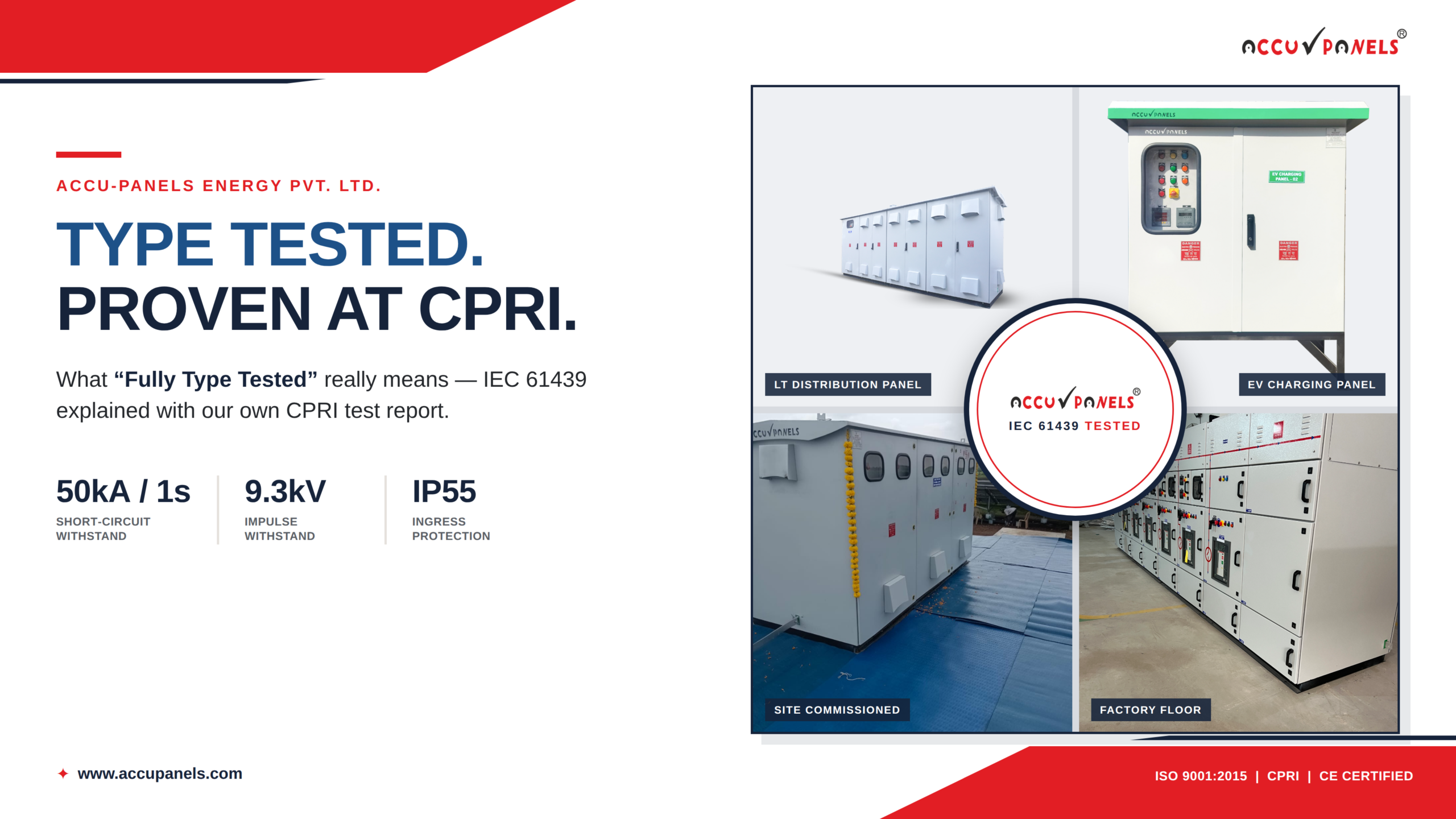
Almost every panel manufacturer in India prints the same three words in their brochure: Type Tested Assembly. However, very few manufacturers can actually show you the laboratory report behind those words.
At Accu-Panels Energy in Ahmedabad, we manufacture LT electrical panels for solar plants, industrial facilities, hospitals, and major infrastructure projects. We recently type-tested our designs per IEC 61439 at CPRI (Central Power Research Institute). Therefore, I want to walk you through what that testing process actually involved—not the polished brochure version, but the unvarnished report version.
The Certificate Everyone Prints, Nobody Explains
If you walk through any electrical exhibition today, every stall claims IEC 61439 compliance and every brochure promises type-tested reliability. However, here is the uncomfortable truth: a framed certificate on a wall tells you virtually nothing unless you know exactly what stands behind it. Consequently, I am sharing the exact technical report details that back ours.
Four Tests, One Panel, One Lab: CPRI Bhopal
Between December 2023 and February 2024, we sent our 800V, 3200A LT panel design to CPRI’s Switchgear Testing and Development Station in Bhopal under serial reference APEPL/23-24/CPRI/01. As a result, lab engineers subjected this single reference assembly to four rigorous attempts to break it.
1. Short-Circuit Withstand Test
During the short-circuit withstand evaluation, the laboratory drove a fault current of 50 kA rms through the main horizontal busbar for a full second, generating an initial peak of 105 kA. Indeed, this simulates the immense physical and thermal force a real-world fault exerts on a busbar system. Furthermore, the official report states the result word-for-word: no abnormality noticed, all busbars and supports found intact, fine wire fuse found intact. Subsequently, the busduct held a 2.5 kV rms high-voltage test for 60 seconds—exactly as required after a short-circuit test—to prove that structural insulation remained fully uncompromised.
2. Temperature Rise Limits
Next, CPRI evaluated temperature rise on our incoming feeder, which is rated at 3200A behind a 4000A ACB, alongside two outgoing feeders running at 630A and 250A. Specifically, the switchgear manufacturer sets a strict temperature rise limit of 65K on the ACB terminals. Over three separate days, technicians held the full rated current steady while thermocouples monitored every joint and terminal. As a result, temperatures remained comfortably within limits across every measured point. Afterwards, we conducted another 2.5 kV rms HV test for 60 seconds to verify that thermal stress had not damaged the surrounding insulation.
3. Impulse & Power Frequency Withstand
To simulate lightning strikes and severe switching surges, we subjected the panel to impulse and power frequency withstand testing. Specifically, CPRI applied a 1.2/50 microsecond impulse wave at a 9.3 kV peak—adjusted for Bhopal’s altitude—using both positive and negative polarities across the main circuit. Fortunately, no disruptive discharge occurred. Additionally, the main circuit held 2.7 kV rms for 60 seconds without breakdown. Meanwhile, because an operator’s hand directly contacts the controls, technicians wrapped metal foil around the operating handles of our 4000A ACB, 630A MCCB, and 250A MCCB to simulate human touch. They then applied 4.05 kV rms for one full minute to each handle. Consequently, all three handles successfully withstood the high voltage.
4. Degree of Protection (IP55)
Furthermore, I want to be completely honest about our IP55 degree of protection testing. Contrary to popular belief, IP55 does not mean a hermetically sealed box. In fact, IEC standards explicitly permit limited dust and water ingress, provided the equipment continues to operate safely afterward. During our laboratory test, inspectors observed small powder traces following the dust chamber, alongside minor moisture traces after the water-jet application. Consequently, this demonstrates IP55 performing precisely as designed rather than indicating a defect. Most importantly, insulation resistance measured well above 2000 megohms after the test concluded. Thereafter, the enclosure held 2.5 kV rms for a full minute without dielectric breakdown, proving that our enclosure protection performs its job under harsh environmental conditions.
As with every CPRI provisional report, the finalized formal documentation follows separately from the institute. However, the verified test numbers remain identical between both versions. Therefore, I prefer showing you the honest provisional data today rather than waiting months simply to make a marketing claim.
One Design Tested to Destruction, Then Every Individual Unit Verified
Here is the vital distinction that buyers rarely hear explained, yet it is the exact detail that protects your plant. Typically, an accredited lab performs a type test once on a prototype design to prove that the architecture survives extreme short circuits, thermal loads, surges, and environmental exposure. However, a type test alone does not prove that the specific panel delivered to your facility was wired and assembled correctly.
For that reason, routine testing remains indispensable. Consequently, every single assembly leaving our Kathwada factory floor undergoes rigorous individual verification before packing:
-
Insulation Resistance: Checked at 1000V DC across all circuits.
-
Dielectric Testing: High-voltage testing applied across every phase-to-phase, phase-to-neutral, and phase-to-earth combination at standard-mandated levels, maintaining zero tolerance for flashover.
-
Protective Earth Continuity: Measured in milliohms to confirm values fall safely below maximum allowable limits.
-
Mechanical Checks: Technicians cycle and verify every door, mechanical interlock, handle, and operating mechanism.
-
Calibration Traceability: We execute all measurements using instruments with live, traceable calibration rather than uncalibrated shop tools.
In summary, a type test validates the overall design blueprint, whereas a routine test verifies the physical unit right in front of you. You need both, yet most buyers are only ever offered one.
Why Untested Panels Still Seduce Buyers
Why do untested panels continue to sell? On day one, a fully certified panel and an untested assembly appear practically identical. For instance, they present the same paint shade, incorporate identical switchgear brands, and showcase equally neat wire ferruling. However, this visual similarity remains deceiving until a real fault strikes.
Typically, an unverified design does not fail during initial commissioning. Instead, it fails in year three at 2 AM, when an unexpected cable fault sends massive fault current through a busbar joint that was never proven to withstand such dynamic forces. At that critical moment, a test report ceases to be administrative paperwork and becomes the deciding factor between a cleanly tripped breaker and a destroyed panel room.
Critical Questions Every Buyer Should Ask
If you are a consultant, EPC contractor, or plant owner, consider asking your panel vendor these five essential questions before releasing your purchase order:
-
Which accredited laboratory tested this design, and can you show me the complete test report rather than a vague one-line certificate?
-
At what exact short-circuit current and duration did the lab test the assembly? (For example, CPRI tested ours at 50 kA for 1 second with a 105 kA peak—ask competitors for their exact metrics.)
-
What was the maximum measured temperature rise at the specific terminals where my field cables connect, and what was the allowed limit?
-
Does every individual panel receive its own serial-numbered routine test report, or does certification exist only for the design prototype?
-
If my custom panel layout differs from your tested reference design, how did your engineering team verify those structural deviations?
Ultimately, a serious manufacturer welcomes these detailed queries. In contrast, hesitation or evasion provides an answer of its own.
Choosing the Hard Route for Proven Safety
Undeniably, type testing requires substantial capital and takes months to complete, carrying a genuine risk that laboratory stresses expose design weaknesses you must subsequently re-engineer. Likewise, routine testing adds a dedicated inspection station and detailed documentation to every single panel without shortcutting quality.
Nevertheless, we chose to do both. Today, our panels power critical hospitals, utility solar plants, and continuous manufacturing facilities. Because human operators stand in front of these switchboards daily, we believe the only honest way to deliver safety is to prove performance in a laboratory long before field deployment. Ultimately, true quality is not what a marketing brochure claims—quality is a verified report number you can inspect at any time.
What is the single most important question you ask a panel vendor before placing an order? Let me know in the comments below.
#IEC61439 #ElectricalPanels #TypeTested #CPRI #ElectricalSafety #AccuPanels
Standards and bodies referenced
- IEC 61439-1 and IEC 61439-2 — low-voltage switchgear and controlgear assemblies (IEC Webstore)
- IEC 60529 — degrees of protection provided by enclosures (IP code)
- Central Power Research Institute (CPRI), Bhopal — independent type-test laboratory
- Bureau of Indian Standards (BIS) — publisher of IS/IEC 61439 in India
See the type-tested platform in practice: PCC panels · MCC panels · 800 V LT panels · Quality and certifications






Why Global Industries Are Switching to IEC 61439 Certified Panels - Accu-Panels Energy
[…] to compare the two standards. For a test-by-test walkthrough of an actual type-test report, read What IEC 61439 type tested actually means: our CPRI report explained. For product specifications see […]