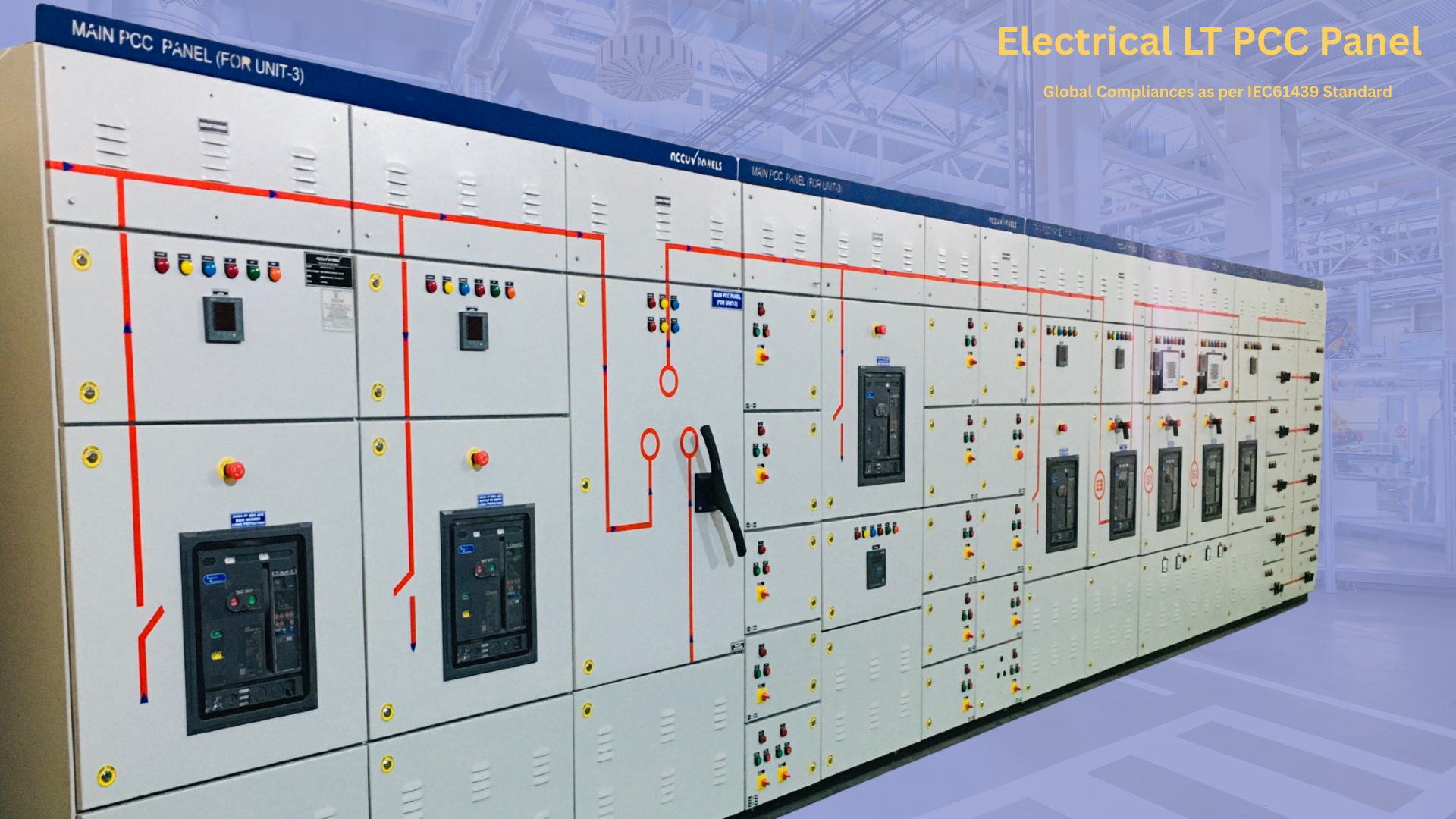
A switchgear assembly is not the sum of its devices. Breakers, contactors and relays carry their own certificates, but the busbars that join them, the joints that hold them and the enclosure that cools them are a separate design that has to be proven. IEC 61439 is the standard that says how.
This article explains why industries specify IEC 61439 certified panels, what the standard replaced, which items are design-verified and how, how IS 8623 compares with IS/IEC 61439, and the difference between a licensed reference design and a manufacturer’s own verified platform. It is written for consultants, EPC engineers and plant buyers evaluating a panel builder’s test evidence.
Figures reflect published standards and product documentation as of November 2026.
Key facts at a glance
- Scope: LV assemblies up to 1,000 V AC / 1,500 V DC
- Verification routes: Test, comparison with a tested design, or assessment (Table D.1)
- Short-circuit withstand: Test or comparison only; never assessment
- Temperature rise by calculation: Only ≤ 630 A single compartment or ≤ 1,600 A per IEC/TR 60890
- Routine verification: Every assembly, incl. 1 s power-frequency dielectric test (clause 11)
In this guide
- What IEC 61439 certified panels actually mean
- From IS 8623 to IS/IEC 61439
- Why industries specify it
- Design-verification items under IEC 61439-1 (Table D.1)
- Routine verification of every assembly
- Licensed reference design versus own design-verified platform
- Buyer checklist for IEC 61439 verification
- Frequently asked questions
What IEC 61439 certified panels actually mean
“Certified” is a market word; the standard uses “verified”. IEC 61439-1 sets general rules for LV assemblies up to 1,000 V AC and 1,500 V DC, and the part standards (-2 power switchgear and controlgear assemblies, -3 distribution boards, -5 feeder pillars, -6 busbar trunking) add product-specific requirements. The original manufacturer carries out design verification; the assembly manufacturer, often the same company, carries out routine verification of every assembly built. A panel design-verified to IEC 61439 (verified by test) has a design proven in a laboratory and units that have each passed routine checks. “Type-tested” survives in Indian tenders as the market name for the same thing.
From IS 8623 to IS/IEC 61439
IS 8623 was based on IEC 60439, which distinguished type-tested assemblies (TTA), proven by test, from partially type-tested assemblies (PTTA), derived from a tested design by calculation. The difficulty was not that one category was unsafe but that the boundary was unclear and PTTA panels were often sold with little evidence. IEC 61439, adopted in India as IS/IEC 61439 by BIS, removed the two categories. Every assembly must now be design-verified, and the standard states for each characteristic which route is permitted: test, comparison with a tested reference design, or assessment. For the characteristics that matter most to safety, test is the only route or one of two.
| Aspect | IS 8623 (based on IEC 60439) | IS/IEC 61439 |
|---|---|---|
| Scope | LV assemblies; TTA and PTTA categories | LV assemblies to 1,000 V AC / 1,500 V DC; one category with defined routes |
| Verification approach | Type tests for TTA; extrapolation for PTTA | Test, comparison or assessment, per characteristic |
| Routine verification | Routine tests | Every assembly: dielectric, PE continuity, wiring and functional checks |
| Rated diversity factor | Diversity factor concept | RDF declared per group of circuits, with assumed-loading tables per part standard |
| Short-circuit withstand | Tested for TTA; derived for PTTA | Test or comparison only; no assessment |
| Global recognition | Withdrawn internationally with IEC 60439 | Current international and Indian standard |
| Documentation | Test certificates | Design-verification report plus routine-verification records per assembly |
Why industries specify it
Fault levels have risen with larger transformers and more motors, so the busbar system’s short-time withstand must be proven, not assumed. Panels run hotter as plants are loaded harder, so temperature-rise verification against IEC 61439-1:2011, Table 6 separates a rating from a guess. Lenders and insurers increasingly ask for the report before acceptance. In India, as of November 2026, large industrial, infrastructure and renewable tenders commonly require a CPRI or NABL-accredited laboratory report against IS/IEC 61439 for the main switchboard. Leading international switchgear manufacturers describe the same shift in their published guidance.
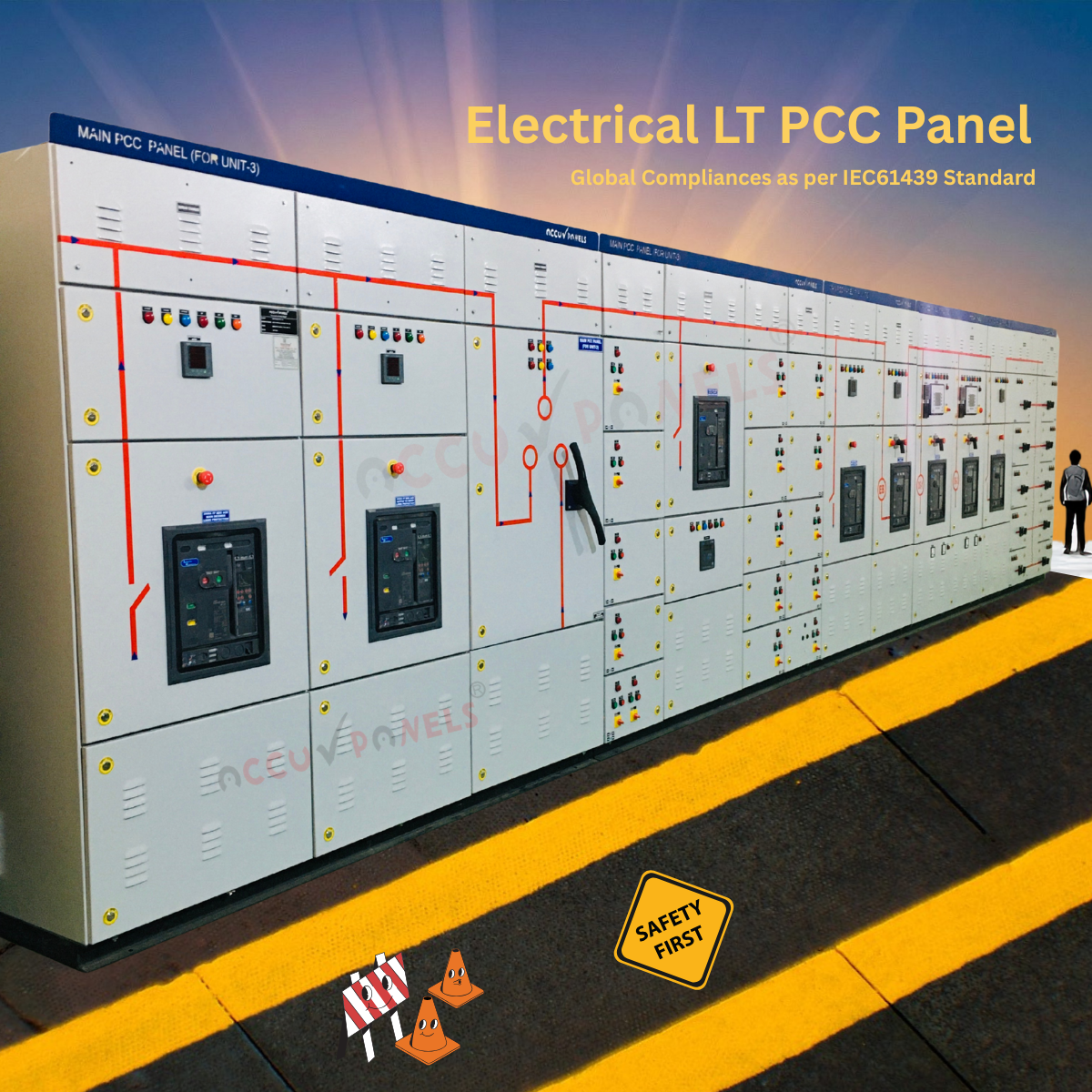
Design-verification items under IEC 61439-1 (Table D.1)
IEC 61439-1:2011, Table D.1 lists the characteristics and routes, paraphrased below.
| Item | What is verified | Permitted route |
|---|---|---|
| 1. Strength of materials and parts | Corrosion, thermal stability, abnormal heat and fire, UV, lifting, impact, marking | Test (thermal stability and fire: test or assessment) |
| 2. Degree of protection | IP code of the enclosure to IEC 60529 | Test or assessment |
| 3. Clearances and creepage distances | Minimum distances for Uimp and Ui at the declared pollution degree | Test |
| 4. Protection against electric shock and integrity of protective circuits | PE continuity (≤ 0.1 Ω at ≥ 10 A) and short-circuit strength of the PE circuit | Test; short-circuit strength by test or comparison |
| 5. Incorporation of switching devices and components | Devices fitted per their standards and the maker’s instructions | Assessment |
| 6. Internal electrical circuits and connections | Conductor sizing, joints, supports | Assessment |
| 7. Terminals for external conductors | Capacity and identification | Assessment |
| 8. Dielectric properties | Power-frequency withstand (2,200 V AC at Ui 1,000 V per Table 8) and impulse withstand | Test (impulse: test or assessment) |
| 9. Temperature rise | Within Table 6 limits at InA and RDF | Test, comparison or assessment |
| 10. Short-circuit withstand | Icw (kA r.m.s. with duration) and Ipk (kA peak) | Test or comparison only |
| 11. Electromagnetic compatibility | Emission and immunity | Test or assessment |
| 12. Mechanical operation | Operating cycles of doors and interlocks | Test |
Temperature rise by calculation is accepted only for single-compartment assemblies up to 630 A, or up to 1,600 A by the method of IEC/TR 60890, at up to 60 Hz. Short-circuit verification may be omitted only when the short-time or conditional current does not exceed 10 kA r.m.s., or a current-limiting device holds the cut-off current to 17 kA or less.
Routine verification of every assembly
Design verification proves the design, not the panel on the truck. IEC 61439-1:2011, clause 11 therefore requires every assembly to pass routine verification: degree of protection, clearances and creepage, PE continuity, incorporation of components, internal connections with sample torque checks, terminals, mechanical operation, a 1 s power-frequency dielectric test (or an insulation-resistance alternative for incomers up to 250 A), wiring and function, and marking. The buyer should receive a signed routine-verification certificate for each panel.
Licensed reference design versus own design-verified platform
Two business models deliver compliant panels, and both are legitimate. In the licensed model, a switchgear manufacturer design-verifies a reference assembly and licenses panel builders to reproduce it with its devices, busbar components and enclosure system; the licensee uses the licensor’s report and must keep to the licensed design. In the own-platform model, the panel builder is the original manufacturer: it designs the busbar system and enclosure, has them verified by test at a laboratory such as CPRI, and may fit devices from more than one reputed series within the scope of its report. The buyer’s question is the same in both cases: does the delivered panel match the busbar section, supports, enclosure and device series in the report? Any departure from the reference, beyond the comparison checklist of IEC 61439-1:2011, Table 13, requires a new test.
A typical specification for a design-verified board is given on the PCC panel product page and the electrical LT panel product page, stating the Icw, form of separation and IP rating to compare against the report. Reading the report itself is covered in the article on IEC 61439 type tests and the CPRI report.
Buyer checklist for IEC 61439 verification
- Ask for the design-verification report; check laboratory, number and date.
- Compare the tested busbar section and support spacing with the drawings.
- Confirm Icw (kA r.m.s. with duration) and Ipk (kA peak) against the site fault level.
- Check that temperature-rise verification covers the offered InA, RDF and device series.
- Witness the dielectric test at the factory acceptance test and obtain the routine-verification certificate; for panels above 415 V, confirm Ui and Uimp on the report match the system.
Frequently asked questions
Is “type-tested” the same as IEC 61439 design-verified?
In the market the words are used interchangeably. “Type-tested” belonged to IEC 60439 and IS 8623; IEC 61439 uses design verification, of which test is one route. A panel described as type-tested should show a design-verification report by test.
Can a panel be IEC 61439 compliant without a laboratory test?
Partly. Several items may be verified by comparison or assessment, but short-circuit withstand needs test or comparison with a tested design, and temperature rise by calculation stops at 1,600 A. For a main switchboard a test report is the normal expectation.
Does IS 8623 still apply in India?
IS/IEC 61439 is the current BIS-adopted standard for LV assemblies. Panels built to IS 8623 remain in service, but new specifications as of November 2026 commonly call for IS/IEC 61439 verification.
Related reading
Disclaimer. This article is general engineering information based on published standards and product documentation as of November 2026. Ratings, settings and protection schemes must be confirmed by a qualified engineer for each installation. Nothing here is a design specification.





Smart, Scalable, Compliant: The New Era of Electrical Panels - Accu-Panels Energy
[…] of solar integration (formerly a separate post). Related reading: future-ready electrical panels, IEC 61439 certified panels and our EV charging LT […]