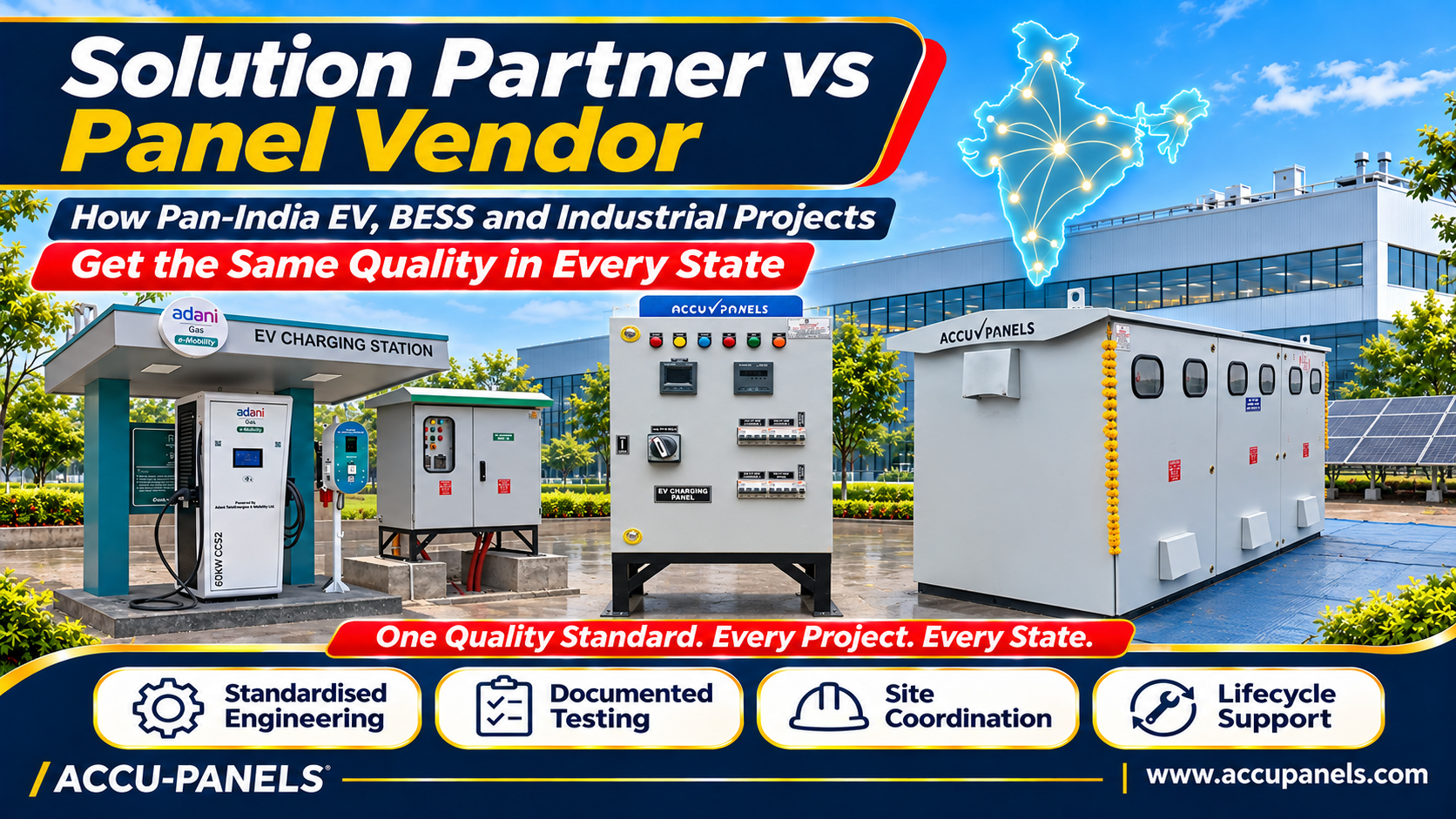
A vendor sells you a panel. A solution partner takes responsibility for the switchroom. The difference shows up at 2 a.m. on commissioning night, in a state where the supplier has never worked before.
National EV, storage and industrial programmes are now built by organisations that commission dozens of sites a year across many states. For them the question is no longer “who makes a good panel” but “who can deliver the same panel, with the same test evidence, to the same drawing, in every state, and stand behind it for twenty years”. This guide explains what an electrical panel solution partner does that a vendor does not, how licensed and independent panel builders differ, what design verification really proves, and how to size and score a partner for a pan-India rollout.
Figures reflect public government data, IEC and BIS standards and published product documentation as of November 2026. Worked examples are illustrative.
Key facts at a glance
- Scope: PCC, MCC, APFC, DBs, feeder pillars, bus duct, ACDB/DCDB and HT under one responsibility
- Compliance: one design-verification file per archetype to IS/IEC 61439-1/-2
- Quality: ISO 9001 with routine verification of every unit
- Comparison rule: a 50 kA test does not cover a 65 kA board
- Capacity check: 240 sites in 18 months ≈ 60 panels a month at peak
In this guide
- Why pan-India programmes need a different kind of supplier
- Panel vendor versus solution partner
- Licensed panel builders and independent manufacturers
- What design verification actually proves
- Worked example: capacity for a 12-state rollout
- What “the same quality in every state” requires
- HT and LT under one responsibility
- Scorecard for choosing an electrical panel solution partner
- Frequently asked questions
Why pan-India programmes need a different kind of supplier
The scale of what is being built has changed. Under PM E-DRIVE, operational guidelines were issued in September 2025 for about 72,300 public EV charging stations, backed by ₹2,000 crore. The subsidised upstream infrastructure explicitly includes the distribution transformer, cables, AC distribution boxes, breakers and protection equipment, so every site carries a panel scope. On the storage side, the Ministry of Power approved a ₹5,400 crore viability gap funding scheme for 30 GWh of BESS, spread across 15 states plus NTPC. India also added a record 44.61 GW of solar in FY 2025-26.
A charge-point operator, storage developer or industrial group rolling out across ten or more states cannot qualify a new panel shop in every region. It needs one design basis, one compliance file and one accountable party. That is the solution-partner model.
Panel vendor versus solution partner
| Dimension | Panel vendor | Electrical panel solution partner |
|---|---|---|
| Scope | Panels per enquiry | The whole distribution basket: PCC, MCC, APFC, DBs, feeder pillars, bus duct, ACDB/DCDB, changeover, and HT where required |
| Design ownership | Builds to the buyer’s drawing | Owns reference designs and their design-verification basis; proposes the single-line |
| Compliance | A certificate per panel | One compliance file per archetype, reused by every site and inspectorate |
| Delivery | Quoted lead time | Reserved capacity, stocked standard enclosures, a published lead-time matrix |
| Site | Dispatch and invoice | Installation drawings, pre-energisation checklist, commissioning supervision |
| Lifecycle | Warranty | AMC with thermography, regional spares, upgrade path for feeders and communication |
| Data | None | Modbus or IEC 61850 metering the buyer’s energy or SCADA system can read |
Licensed panel builders and independent manufacturers
Most large switchgear groups worldwide run panel-builder programmes. A licensed builder assembles the licensor’s design-verified system (busbar, enclosure and devices) under licence, uses its configuration software and is listed in a partner directory. The licensor holds the design-verification evidence; the builder performs routine verification and owns the local relationship. The same model operates in India. It gives a predictable product, with two limits: customisation stays inside the licensor’s design, and quality still depends on each builder’s factory discipline.
An independent manufacturer with its own CPRI-tested platform sits at the other end. It owns the design verification, can engineer project-specific variants, and serves several states from one factory with trained installation partners. Neither model is better by category. The buyer’s three questions are the same for both: who holds the design-verification evidence for the exact rating offered, who holds the routine-test record for each unit, and who answers the phone on site.
What design verification actually proves
India has moved fully to the IEC 61439 framework: the older IS 8623 parts have been withdrawn and replaced by IS/IEC 61439, with Parts 1 and 2 adopted in their 2020 editions. Under this framework the market term “type-tested” really means design-verified: each design characteristic is verified by test, by comparison with a tested reference design, or by assessment, and every built unit then receives routine verification.
| Characteristic | Permitted verification routes | What to ask a partner for |
|---|---|---|
| Short-circuit withstand | Test or comparison with a tested reference design; never assessment | Test report at the busbar rating and fault level offered, or the comparison record |
| Temperature rise | Test, comparison or calculation within strict limits | Test report for ratings above the calculation limits |
| Dielectric (power-frequency) | Test | Report at the rated insulation voltage |
| Clearances and creepage | Test (measurement) | Values for the pollution degree and voltage offered |
| Degree of protection (IP) | Test or assessment | IP report for the enclosure family |
The comparison route matters most for national programmes. Under IEC 61439-1 (Table 13 in the 2011 edition), a variant can rely on a tested reference design only if every item on the checklist holds: rating not above the reference, busbar section and spacing not smaller, same support type at the same or closer spacing, same conductor material, protective devices of the same make and series, and an enclosure of the same design. A single “no” means a new test. A 50 kA certificate therefore does not cover a 65 kA board.
Worked example: capacity for a 12-state rollout
Assumptions: a charge-point operator commissions 240 hub sites across 12 states in 18 months. Each site needs three panels (main LT panel, EV charging panel and feeder pillar). Orders peak at 1.5 times the average before the financial-year end. The shortlisted factory builds 150 panels a month across all customers.
Peak monthly demand = (sites × panels per site ÷ months) × peak factor
| Step | Input / formula | Result |
|---|---|---|
| 1. Total panels | 240 × 3 | 720 panels |
| 2. Average rate | 720 ÷ 18 | 40 panels per month |
| 3. Peak rate | 40 × 1.5 | 60 panels per month |
| 4. Share of factory output at peak | 60 ÷ 150 | 40 % |
| 5. Design files with archetypes | 3 site archetypes × 3 panels | 9 designs instead of up to 720 bespoke ones |
Engineering takeaway. At 40 % of a factory’s peak output, the programme needs a written capacity reservation, stocked enclosures and a lead-time matrix, or a second qualified source building the same archetypes. Standardising on a few site archetypes cuts the engineering and compliance load from hundreds of drawings to nine verified designs.
What “the same quality in every state” requires
- One platform. A single busbar system, enclosure family and construction standard across the range, so a PCC in one state and a feeder pillar in another share parts and documents. A typical example is an LT panel platform covering PCCs from 800 A to 6,300 A at 50–80 kA, MCCs up to 6,300 A in Form 3b/4b, APFC from 20 to 3,000 kVAr, feeder pillars and 800 V solar panels on one basis.
- One compliance file per archetype, referenced by every site and accepted by every inspectorate.
- One quality system. ISO 9001 with routine verification of every unit: wiring and function, dielectric test, protective-circuit continuity, mechanical operation, clearances and IP checks, with the record filed against the serial number.
- One documentation set. GA, schematic, BOM, routine-test certificate and O&M manual in the same format for every panel.
- Regional installation partners trained to the manufacturer’s checklist, with the manufacturer supervising the first sites in each region.
- Regional spares and AMC with response times written into the contract.
HT and LT under one responsibility
Large sites increasingly want one responsibility from the 11 or 33 kV incomer to the last distribution board. The partner must either manufacture or integrate the HT switchgear, handle the utility connection documents, and design the LT side to the HT side’s fault level and protection grading. Ask for the HT–LT coordination study as a deliverable, not an extra. For BESS sites the connection voltage also sets the compliance path: CEA’s new BESS safety chapter applies to systems connected above 650 V from 1 April 2027.
Scorecard for choosing an electrical panel solution partner
Score each criterion from 1 to 5, multiply by the weight and divide the total by 5 to get a score out of 100. The two suppliers below are illustrative.
| Criterion | Weight | Supplier A | Supplier B |
|---|---|---|---|
| Design-verification evidence for the rating offered | 25 | 5 | 2 |
| Routine-test and QA records | 15 | 4 | 3 |
| Capacity and lead-time plan | 15 | 3 | 5 |
| Engineering depth (SLD, studies, HT–LT) | 15 | 4 | 2 |
| Regional installation and service | 15 | 3 | 5 |
| Documentation and data (Modbus / IEC 61850) | 10 | 4 | 3 |
| Financial and team continuity | 5 | 4 | 4 |
| Total (out of 100) | 100 | 79 | 65 |
Supplier B looks stronger on delivery and reach, but its weak design-verification evidence is the one gap that cannot be closed during the programme. Supplier A’s capacity gap can be closed with a reservation agreement. Weight technical evidence highest, because it is the hardest thing to fix later.
Verify the scores in person: visit the factory (fabrication, multi-tank pre-treatment, powder coating, HV test bay and routine-test records), see reference sites in your sector, and read the test reports yourself. The quality and testing evidence a partner publishes is a useful starting point, not a substitute for the visit.
Frequently asked questions
What is the difference between a panel vendor and a solution partner?
A vendor supplies panels to the buyer’s drawing. A solution partner owns the reference designs and their verification evidence, supplies the full distribution scope, supports installation and carries the lifecycle across every site.
Is a licensed panel builder better than an independent manufacturer?
Neither is better by category. Check who holds the design-verification evidence for the exact rating offered, how customisation is handled and how the factory performs routine verification.
What is the minimum compliance file for a national programme?
Design-verification evidence to IS/IEC 61439-1 and -2 for each archetype (short circuit, temperature rise, dielectric, clearances, IP), ISO 9001 certification and a routine-test certificate for every panel.
Does a 50 kA test certificate cover a 65 kA panel?
No. A design can rely on a tested reference only if its rating does not exceed the reference and every comparison criterion is met; a higher fault level needs its own test.
Related reading
Disclaimer. This article is for general technical education and reflects public government data, IEC and BIS standards and published product documentation as of November 2026. The worked example and scorecard use stated assumptions and illustrative suppliers. Partner selection, scope, compliance evidence and commercial terms must be assessed for each programme. Nothing here is a design specification, a commercial offer or an endorsement of any organisation.