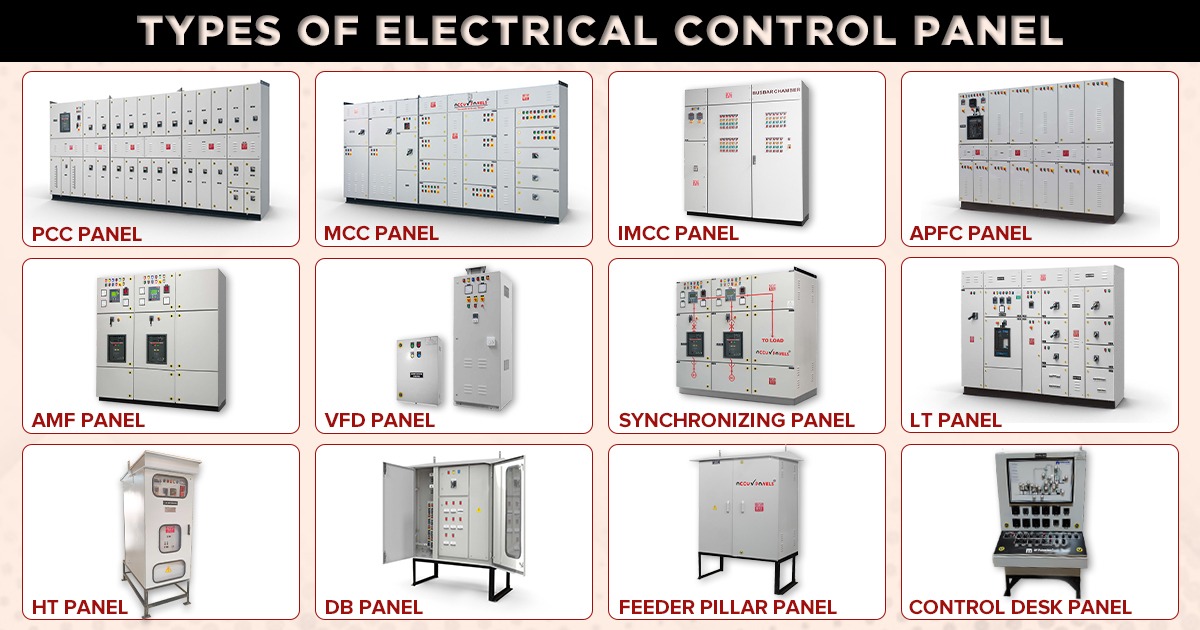
An electrical panel is defined by what it switches, not by what it looks like. A sheet-steel cubicle with an ACB inside may be a distribution board, a motor control centre, a generator synchroniser or a solar inverter interface, and the ratings, standards and protection logic differ for each. Knowing the type is the first step in writing a specification that a manufacturer can price and a consultant can approve.
This guide lists the types of electrical panels used in Indian industrial, commercial and renewable projects, grouped by application, with the typical rating range and the governing standard for each. It then explains the main types in more detail, covers the construction features common to all, and answers the questions most often asked at the specification stage. It is written for plant engineers, consultants, EPC estimators and procurement teams.
Figures reflect published standards and product documentation as of November 2026.
Key facts at a glance
- PCC rating: 800 to 6,300 A, 50 to 80 kA
- APFC range: 20 to 3,000 kVAr
- Solar LT panel: 800 V AC, up to 6,300 A
- EV charging LT panel: 250 to 4,000 A, up to 85 kA
- Assembly standard: IS/IEC 61439 (replaced IS 8623)
In this guide
Types of electrical panels: quick reference
| Panel type | What it does | Typical rating | Key standard |
|---|---|---|---|
| PCC panel | Main LT distribution from transformer or DG | 800 to 6,300 A; 50 to 80 kA | IEC 61439-2 |
| MCC panel | Motor starting, control and protection | 400 to 6,300 A | IEC 61439-2, IEC 60947-4-1 |
| Intelligent MCC / Drawout MCC | Communicating, live-maintainable motor control | Form 4b | IEC 61439-2, IEC 61850 / Modbus |
| APFC panel | Automatic power factor correction | 20 to 3,000 kVAr | IEC 61439, IEC 60831 |
| AMF panel / ATS | DG auto-start and mains-DG transfer | 32 to 3,200 A | IEC 61439, IEC 60947-6-1 |
| Synchronising panel | Parallel operation of DGs, grid and solar | Up to 6,000 A | IEC 61439-2 |
| VFD / soft-starter panel | Variable-speed and reduced-current motor starting | 0.75 to 1,000 kW | IEC 61800-5-1, IEC 60947-4-2 |
| Bus duct | Enclosed busbar from transformer to PCC | Up to 6,300 A | IEC 61439-6, IS 8623 |
| PDB / LDB / Feeder pillar | Sub-distribution to power, lighting and outdoor loads | 63 to 1,600 A | IEC 61439-3, IEC 61439-5 |
| Solar ACDB / DCDB, AJB, AC combiner | PV string combining and inverter output distribution | 1,000 / 1,500 V DC; 415 / 800 V AC | IEC 61439, IEC 60269-6, IEC 61643 |
| 800 V solar LT panel | Inverter-to-transformer LV switchboard | 800 V, up to 6,300 A | IEC 61439-2 |
| NVR / TVM / Meter panel | Grid-interface protection and utility metering | Up to 800 A | IEC 60255, DISCOM specifications |
| EV charging LT panel | Distribution to charger clusters | 250 to 4,000 A; up to 85 kA | IEC 61439, IEC 61851 |
| BESS AC / DC panels | Battery-to-PCS and PCS-to-grid distribution | 1,000 to 1,500 V DC; 415 to 800 V AC | IEC 61439, IEC 62933 |
Panels by application
Industrial and power plants
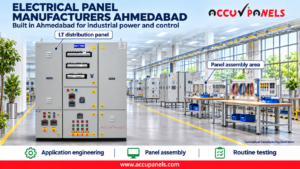
The core set is the PCC, the MCC and its drawout and intelligent variants, the APFC panel, the AMF or ATS panel, the VFD and soft-starter panel, the PLC or automation panel and the synchronising panel. Large plants add a bus duct between transformer and PCC, HT or MV switchgear on the incoming side, sub-distribution boards and feeder pillars for outdoor loads, and control desks for operator stations.
Commercial buildings and utilities
Buildings use the same LT main panel, with lighting control panels, fire-alarm control panels, UPS input and output panels, changeover panels for the DG, floor distribution boards and, on campuses, feeder pillars at street level. Surge protection panels are placed at the service entrance where lightning exposure or sensitive loads justify them.
Power infrastructure
Between the DISCOM and the plant sit the LT, MV or HT switchgear, the ring main unit, the metering panel and the substation interface panel with the transformer protection relays.
Solar plants
| Panel | Role in a PV plant |
|---|---|
| Array junction box / string combiner | Combines strings with gPV fuses, DC SPD and DC isolator at the array |
| DCDB | DC combining near the inverter on rooftop and small plants |
| ACDB / AC combiner | Parallels inverter outputs, protects and meters them |
| Solar LT panel (415 or 800 V) | Collects inverter output at the inverter transformer, up to 6,300 A |
| Inverter interface and auxiliary panels | Auxiliary supply, UPS and battery panels for plant controls |
| HT panel, RMU, ICOG | Medium-voltage switching and the interconnection with the grid |
| NVR, anti-islanding, ABT meter and transformer protection panels | Grid-interface protection and settlement metering |
EV charging hubs
An EV charging site needs a charger infrastructure LT panel feeding the charger clusters, a metering panel, a source changeover for DG or BESS back-up, a transformer panel where a dedicated transformer is installed, SCADA and IoT panels for the charge-point management system, fire-safety interfaces, and the grid-interface, RMU and ABT metering panels on the supply side.
Battery energy storage
A BESS block has a battery bank panel on the DC side, a BESS DCDB and ACDB around the power conversion system, a control and SCADA panel, a synchronising or changeover panel where the system can island, and the RMU and ABT metering panels at the grid connection.
Power control centre in detail
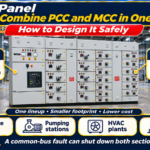
The PCC is the main LT switchboard, installed directly after the transformer or the DG set. It contains the ACB incomer, MCCB and ACB outgoing feeders, MCBs for auxiliaries, and aluminium or copper busbars sized by temperature-rise verification. The incoming side of the main breaker remains live whenever the transformer is energised, which is why the incomer compartment is separated and labelled. PCCs in India operate at 415 V or 433 V, and at up to 800 V AC in solar and BESS plants. The busbar short-circuit withstand Icw is stated in kA r.m.s. with its duration, typically 50 kA or 65 kA for 1 s, and the peak withstand Ipk in kA peak.
Motor control centre in detail
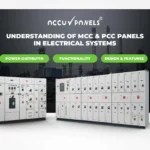
The MCC is fed from a PCC feeder and holds one functional unit per motor. Each unit carries short-circuit protection (MCCB or motor-protection circuit breaker), a contactor, an overload relay or electronic motor protection, and the control components for local and remote operation. Starters are direct-on-line, star-delta, soft starter or VFD. Fixed MCCs are the lowest cost; semi-drawout and fully drawout MCCs allow a starter to be withdrawn and replaced with the busbar live, which is why they are specified with Form 4b separation in continuous-process plants.

Automation and intelligent MCC
An automation panel houses the PLC, remote I/O, communication modules and operator interface that run the process. An intelligent MCC brings motor management into the MCC itself: each starter has a motor-management relay that measures current, thermal state and trip history and reports over Modbus, Profibus or IEC 61850 to the control system. The result is modular management of every LV motor from the automation system, with predictive maintenance data and safety-related disconnection built into the starter module rather than wired separately.
Construction and finish common to all types
- Enclosure in 2.0 mm CRCA for frames and 1.6 to 2.0 mm for doors, laser cut and bolted or welded.
- Seven-tank pre-treatment (degreasing, rinsing, de-rusting, phosphating, passivation) followed by powder coating; C4 or C5 coating systems for coastal or chemical environments.
- Busbars of uniform cross-section along the panel, supported on SMC or DMC insulators spaced to the design-verified short-circuit rating.
- Earth bar running the length of the panel, bonded to every door and gland plate.
- Internal wiring colour-coded, ferruled and terminated on numbered terminals matching the schematics.
- Routine verification of every unit: insulation resistance, power-frequency dielectric test, protective-circuit continuity and functional test.
Under IS/IEC 61439 an assembly is design-verified by test, by comparison with a tested reference design, or by assessment, and every unit receives routine verification; the market term “type-tested” refers to a design verified by test, commonly at CPRI. Leading international manufacturers publish their switchboard ranges on the same basis: one design-verified frame and busbar platform configured as PCC, MCC, PMCC or distribution board.
Frequently asked questions
What is the difference between a control panel and a power panel?
A power panel distributes electrical energy through breakers and busbars. A control panel controls equipment through relays, PLCs and starters. Most industrial panels combine both: the MCC distributes power to motors and controls them.
Which standard governs LT panels in India?
IS/IEC 61439 for the assembly, which replaced IS 8623. The devices inside follow the IEC 60947 series and the enclosure IP code follows IEC 60529. A design-verification report from a laboratory such as CPRI is the accepted proof.
What is the difference between LT and HT panels?
LT panels operate below 1,000 V AC, commonly 415 V, 690 V or 800 V, with ACBs and MCCBs. HT panels operate at 3.3 kV to 33 kV with vacuum circuit breakers and are built to a different standard series.
When should a drawout panel be chosen over a fixed one?
Where a feeder or starter must be replaced without shutting down the busbar, as in continuous-process plants. Fixed panels cost less and suit plants that can schedule shutdowns.
Which panels does a solar plant need?
Array junction boxes on the DC side, AC combiner or ACDB panels at the inverters, an 800 V or 415 V LT panel at the inverter transformer, and NVR and metering panels at the grid interface.
Related reading
Disclaimer. This article is general engineering information based on published standards and product documentation as of November 2026. Ratings, settings and protection schemes must be confirmed by a qualified engineer for each installation. Nothing here is a design specification.






Choosing the Right Electrical Control Panel Manufacturer - Accu-Panels Energy
[…] portfolio to evaluate the range and quality of services they offer. Also, inquire about the Types of electrical control panels they have successfully manufactured in the past. This will help you understand the scope of their […]
Ghanshyam Soni
Selecting an electrical control panel manufacturer plays a vital role in the efficiency, safety, and success of your operations. By evaluating industry experience, engineering expertise, certifications, support services, and customization capabilities, businesses can make confident, informed decisions. Accu-Panels Energy stands out in India for its innovation, quality assurance, and wide portfolio of certified electrical panels.
What Needs to Be Considered When Selecting a Control Panel:
Intended application and operating environment
Voltage and current requirements
Type of enclosure and IP rating
Component compatibility with existing systems
Compliance with standards like IEC 61439
Scalability for future upgrades
Safety features and ease of operation
Thorough evaluation of technical, operational, and support factors leads to smarter investments and long-term reliability.